
Munch

Summary
Edvard Munch (1863–1944) was a profoundly influential Norwegian artist whose deeply personal and emotionally intense work explored the complexities of human mortality, psychological suffering, and spiritual longing. Emerging as a pioneering figure of both Symbolism and Expressionism, Munch redefined art’s capacity to express internal emotional and existential realities. His vivid color palettes, often charged with symbolism, and his innovative use of abstraction and distortion created haunting imagery that delved into themes such as illness, sexual awakening, anxiety, and death. While many contemporaries were influenced by French Impressionism, Munch’s art drew more directly on Symbolist ideals, notably inspired by artists like Paul Gauguin. His work challenged conventional representation, blending landscape and portraiture into profound meditations on the human condition and psyche.
Childhood and Education
Edvard Munch was born on December 12, 1863, in a modest farmhouse in Ådalsbruk, a village in the rural municipality of Løten, Norway. He was the second of five children in a household overshadowed by frequent tragedy and instability. His father, Christian Munch, was a military doctor whose strict religious beliefs and melancholic temperament deeply influenced the young artist. The family endured a series of devastating losses: Munch’s mother died of tuberculosis when he was just five, and several of his siblings also succumbed to illness during his childhood. These early experiences with death and grief profoundly shaped Munch’s worldview and would become recurring motifs throughout his artistic career.
As a frequently sickly child, Munch spent much time indoors, where he began drawing and painting as a form of solace and self-expression. He was encouraged by local artists and exhibitions, which introduced him to landscape painting and the techniques of oil paint. His early art education was largely self-directed, but he did later attend the Royal School of Art and Design in Kristiania (now Oslo), where he studied under teachers who exposed him to both traditional and contemporary artistic currents.
Early Career
In the 1880s, Munch embraced a bohemian and intellectual lifestyle in Kristiania, becoming part of the Kristiania Boheme, a group of radical young artists and writers who rejected the conservative values of Norwegian society in favor of emotional freedom and authenticity. Influenced by figures like the writer Hans Jæger, Munch was encouraged to explore themes of passion, alienation, and suffering in his art.
One of his earliest major works, The Sick Child (1885–86), was a poignant tribute to his sister Sophie, who had died of tuberculosis. This painting revealed Munch’s interest in expressing raw emotional experience rather than mere physical likeness. His work began to attract attention for its psychological depth and innovative style.
In 1889, Munch received a state scholarship that enabled him to travel to Paris and study under Léon Bonnat. During his time in Paris, he encountered the vibrant scenes of Impressionism and Post-Impressionism, meeting the works of Manet, Gauguin, and van Gogh. Although he admired these contemporaries, Munch’s art retained a darker, more introspective tone, focusing on existential anxieties and inner turmoil. The death of his father that same year further intensified these themes.
Mature Period
Munch’s international breakthrough came in the early 1890s, particularly with a solo exhibition in Berlin in 1892. The show was abruptly closed by authorities due to its provocative content, but the resulting scandal only heightened Munch’s reputation across Europe. His deeply emotional and sometimes disturbing imagery resonated with audiences fascinated by the new Symbolist movement.
In 1893, Munch presented a series of six paintings exploring complex themes of love, anxiety, and death. These works formed part of his ambitious Frieze of Life, a poetic cycle that would become central to his oeuvre. Among the most iconic paintings from this period are The Scream (1893), which became a symbol of modern existential dread; Love and Pain (also known as Vampire, 1893–94); Ashes (1894); Madonna (1894–95); and Puberty (1895). These works are characterized by expressive brushwork, dramatic colors, and symbolic motifs that communicate the turbulence of the human psyche and the inevitability of death. Alongside painting, Munch pursued photography, experimenting with it as a secondary medium to document and study emotional expression, though it never overshadowed his painting and printmaking practice.
Late Period
Munch’s life was marked by ongoing struggles with mental health and substance abuse. In 1908, after years of emotional strain, he suffered a nervous breakdown and was hospitalized in Copenhagen. During this period of recovery, he created the Alpha and Omega lithograph series, which reflected mythic and deeply personal themes, signaling a period of introspection and spiritual exploration.
Returning to Norway in 1909, Munch adopted a quieter lifestyle in the countryside near Oslo. His later work showed a noticeable shift toward lighter color palettes and freer brushstrokes. He revisited landscapes, rural scenes, and more optimistic themes, as seen in paintings like The Sun (1912), Spring Ploughing (1916), and Bathing Men (1918). Despite this brighter tone, existential themes remained present in his oeuvre. In his final decades, Munch produced many self-portraits that continued to probe his aging and mortality.
During the Nazi occupation of Norway in World War II, many of Munch’s works were labeled “degenerate” and confiscated, though they were eventually recovered. Munch passed away on January 23, 1944, in Oslo, after years of deteriorating health and vision.
Legacy
Edvard Munch’s impact on modern art is vast and enduring, particularly within German Expressionism. His emotionally charged use of color and form profoundly influenced artists like Ernst Ludwig Kirchner, Wassily Kandinsky, and Max Beckmann, who admired his ability to depict psychological and emotional states through bold distortion and abstraction. Munch’s pioneering approach anticipated later movements such as Symbolism, Surrealism, and Abstract Expressionism.
His intense focus on inner emotional landscapes paved the way for artists like Francis Bacon, who similarly explored themes of psychological torment and existential anxiety. Munch’s artistic legacy is preserved in Oslo, where he bequeathed over a thousand paintings, thousands of drawings, and nearly twenty thousand prints to the city. These works form the core of the Munch Museum, established in 1963, which remains one of the most important collections of modern art in Europe.
Today, Munch is best known for The Scream, a universal icon of modern angst, but his broader body of work stands as a testament to his visionary ability to articulate the fragility, pain, and complexity of the human experience with unprecedented emotional intensity and artistic innovation.
Showing all 2 results
-
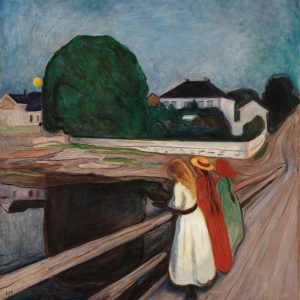
The Girls on the Bridge
$276.00 – $904.00Price range: $276.00 through $904.00 Select options This product has multiple variants. The options may be chosen on the product page -
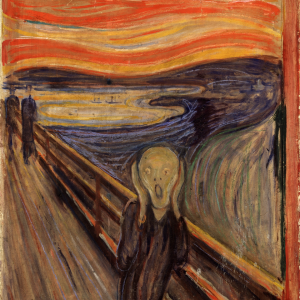
The Scream
$276.00 – $696.00Price range: $276.00 through $696.00 Select options This product has multiple variants. The options may be chosen on the product page