
Raphael
Summary
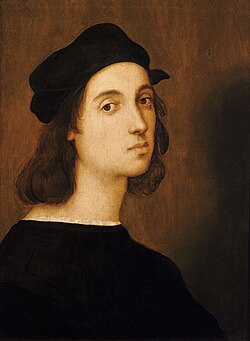
Raffaello Sanzio da Urbino, known simply as Raphael, stands as one of the most luminous figures of the Italian High Renaissance. His career, though tragically brief—ending at the age of just 37—was marked by extraordinary productivity and refinement. Alongside Leonardo da Vinci and Michelangelo, Raphael is often regarded as part of the “trinity” of Renaissance masters. His work, celebrated for its clarity, harmony, and embodiment of Renaissance Humanist ideals, set a standard for beauty and balance that defined an era and influenced centuries of art to come.
Childhood
Raphael was born in Urbino, a thriving cultural center under the patronage of Duke Federico da Montefeltro. His father, Giovanni Santi, was court painter to the Duke, leading a respected workshop. Raphael’s mother, Magia di Battista di Nicola Ciarla, came from a prosperous merchant family. Of their three children, Raphael was the only one to survive into adulthood. His mother died in 1491, when Raphael was just eight years old, and his father remarried the following year.
Giovanni Santi gave Raphael his earliest artistic training, and by all accounts, the boy showed exceptional promise. According to Giorgio Vasari’s Lives of the Artists (1550), Raphael was placed in the workshop of Pietro Perugino at a young age, where he absorbed the graceful clarity and balanced compositions that defined his teacher’s style. When Giovanni died in 1494, Raphael—still in his teens—was placed under the guardianship of his uncle, but continued working in his father’s workshop.
Early Training and Work
Raphael’s formal apprenticeship with Perugino shaped his early style so closely that his paintings were almost indistinguishable from his master’s. By the age of 17, he was recognized as an independent master. His first documented commission came in 1500, for an altarpiece dedicated to St. Nicholas of Tolentino in Città di Castello. While this work was later damaged in an earthquake, its surviving fragments show the precision and grace that became hallmarks of Raphael’s art.
Other important commissions soon followed, including the Coronation of the Virgin (1502) for the Oddi Chapel in Perugia, and The Marriage of the Virgin (1504), an ambitious composition inspired by Perugino’s Christ Delivering the Keys to Saint Peter. These works cemented Raphael’s reputation as a painter of refined composition and harmonious beauty.
In 1504, Raphael traveled to Florence, then the epicenter of the Italian Renaissance. There, he encountered Leonardo da Vinci and Michelangelo. Their mastery of anatomy, perspective, and expressive power profoundly influenced him. Raphael began to integrate Leonardo’s techniques of chiaroscuro and sfumato, as well as the sculptural dynamism evident in Michelangelo’s figures, into his evolving style. His Madonna paintings from this period, such as La Belle Jardinière (1507), epitomize the serene grace and subtle realism that defined his Florentine work.
Mature Period
In 1508, at the recommendation of architect Donato Bramante, Pope Julius II invited Raphael to Rome. This marked the beginning of the most productive phase of his career. While Michelangelo worked on the Sistine Chapel ceiling, Raphael began frescoing the papal apartments (the Stanze) in the Vatican. His work there, including The School of Athens, established him as the leading painter of the papal court and earned him the title “Prince of Painters.”
Raphael’s Roman period also saw major commissions from private patrons, most notably banker Agostino Chigi, for whom he painted The Triumph of Galatea at the Villa Farnesina. His architectural skills were recognized with commissions such as the Chigi Chapel in Santa Maria del Popolo and contributions to the design of St. Peter’s Basilica, where he succeeded Bramante as chief architect in 1514.
Despite his engagement to Maria Bibbiena, niece of Cardinal Bernardo Dovizi, Raphael’s great love was Margherita Luti, known as “La Fornarina,” who became his muse and model. Their relationship, often romanticized, is immortalized in portraits like La Fornarina (1518–19).
Late Period
In 1517, Pope Leo X appointed Raphael Commissioner of Antiquities, entrusting him with the preservation of Rome’s ancient monuments. He also oversaw the creation of a detailed archaeological map of the city, demonstrating his broad intellectual and artistic interests.
During these years, Raphael produced designs for the celebrated Sistine Chapel tapestries, woven in Flanders, and continued major architectural projects such as the Villa Madama. His workshop grew to over fifty assistants, the largest of any painter at the time, allowing him to complete vast commissions across multiple disciplines.
Raphael’s final painting, The Transfiguration (1520), commissioned for Narbonne Cathedral, reflects his mature synthesis of dramatic composition and spiritual intensity. It was left on his easel at the time of his death.
Death
Raphael died in Rome on April 6, 1520—his 37th birthday—after a short illness. His funeral was one of the most elaborate of the era, attended by dignitaries, artists, and patrons. In his will, Raphael requested burial in the Pantheon, where his tomb remains, inscribed with Pietro Bembo’s tribute: “Here lies that famous Raphael by whom Nature feared to be conquered while he lived, and when he was dying, feared herself to die.”
Legacy
Raphael’s refinement of Renaissance ideals influenced generations of artists and established enduring standards of beauty and composition. His work was considered the pinnacle of artistic achievement, studied and emulated from the 16th through the 19th centuries. Even those who rejected Renaissance ideals, such as the Pre-Raphaelite Brotherhood, defined themselves in opposition to the perfection Raphael represented.
His legacy extends to artists as diverse as Titian, Poussin, Reynolds, Ingres, and Renoir. Raphael’s ability to harmonize technical mastery with emotional resonance ensures his place as one of the greatest artists in history—his fame, as predicted by contemporaries, remains eternal.