
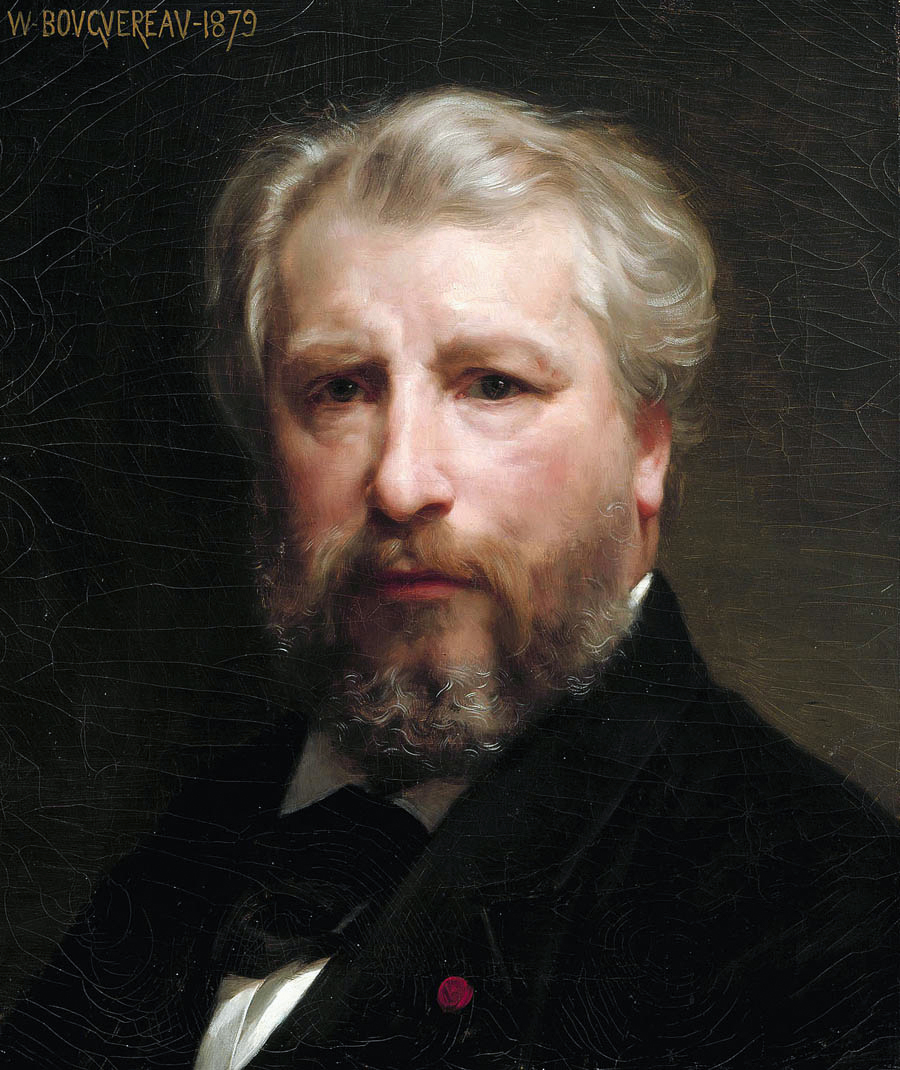
William Bouguereau
Summary
Few artists of the modern period experienced a reversal of reputation as stark as William-Adolphe Bouguereau (1825–1905). During his lifetime, this French Neoclassical painter was one of the most celebrated and commercially successful artists in the Western world, beloved by the bourgeoisie and honored by the French Academy. His meticulously rendered mythological tableaux, religious works, idealized nudes, and sentimental depictions of rural life were executed with technical brilliance and produced in great quantity for a devoted clientele. Yet, after his death, as academic painting fell from favor and avant-garde movements defined the narrative of modern art, Bouguereau was dismissed as emblematic of an outdated establishment, his style criticized as formulaic and overly polished. In recent decades, reassessment has restored appreciation for his extraordinary skill, traditional sensibilities, and influential role in 19th-century art.
Childhood and Education
Bouguereau was born in 1825 in La Rochelle, a port city in southwestern France. His father, a wine and olive oil merchant, was Roman Catholic, while his mother came from a Calvinist family. Their compromise—raising sons as Catholics and daughters as Protestants—shaped Bouguereau’s early life, which was disciplined but enriched by a strong sense of local culture. At twelve, he was sent to live with his uncle, a Catholic priest, where he experienced what he later described as “the happiest time of my life,” steeped in classical literature, nature, and religious instruction.
He continued his education at the Catholic college in Pons, where he received his first formal art instruction from Louis Sage, a follower of Ingres. After the family moved to Bordeaux, he trained at the Municipal School of Painting and Drawing under Charles Marionneau, financing his studies by producing commercial lithographs. Determined to pursue an artistic career, Bouguereau moved to Paris in 1846 to study under François-Édouard Picot, a respected Neoclassical painter. His ambition was clear: to win the coveted Prix de Rome, granting study at the French Academy in Rome. After two failed attempts, he succeeded in 1850 with Zenobia Found by Shepherds on the Banks of the Arax, a composition echoing Poussin.
Mature Career
Bouguereau spent three years in Rome (1851–54), refining his craft while studying Renaissance and classical art. Returning to France, he quickly established himself at the Paris Salon. His skill and fidelity to the Neoclassical style appealed to middle- and upper-class patrons, leading to state commissions and significant public works, including Napoleon III Visiting the Floods of Tarascon (1856). His career flourished under the representation of prominent dealers Paul Durand-Ruel and Adolphe Goupil, ensuring steady demand.
From the 1860s, Bouguereau adapted his subjects to evolving tastes, adding Naturalist-inflected scenes of rural life to his repertoire while continuing to produce mythological and religious works. His paintings of young shepherdesses, peasant girls, and idyllic rustic scenes were crafted with the same technical precision as his grand historical canvases. While pragmatic in his approach to subject matter, he remained staunchly conservative in artistic politics, defending traditional academic standards. He was instrumental—alongside Alexandre Cabanel—in the rejection of Édouard Manet’s Déjeuner sur l’Herbe from the 1863 Paris Salon, prompting the establishment of the Salon des Refusés, a pivotal moment for the avant-garde.
Bouguereau maintained an active personal and professional life, dividing his time between Paris and La Rochelle. In 1856, he began a relationship with his model Nelly Monchablon, whom he married in 1866; they had five children, though only two survived infancy.
Late Career and Teaching
Bouguereau’s professional acclaim reached its peak in the later decades of the 19th century. He became a lifetime member of the Académie des Beaux-Arts in 1876 and was named Commander of the Legion of Honor in 1885—the highest recognition for a living artist in France.
His personal life, however, was marked by tragedy: three of his children died young, and his wife Nelly passed away in 1877. These losses influenced a series of more solemn religious paintings. Later, Bouguereau formed a lasting partnership with American painter Elizabeth Jane Gardner, one of his former students, whom he married in 1896 after a twenty-year engagement.
Alongside his prolific studio practice, Bouguereau became a dedicated teacher, particularly at the Académie Julian, where he championed rigorous academic training. Remarkably for the era, he advocated for women’s admission to professional art instruction, mentoring numerous female artists who would go on to significant careers.
Death and Legacy
Bouguereau continued to work tirelessly into his final years, remaining committed to the Academic style even as avant-garde movements dominated the art world. He died in 1905 in La Rochelle and was buried in Montparnasse Cemetery in Paris alongside his first wife and children.
In the decades following his death, Bouguereau’s reputation declined sharply, overshadowed by the rise of Impressionism and modernism. For much of the 20th century, his name became synonymous with conservative taste and academic excess. His work was often criticized for catering to bourgeois sensibilities with idealized nudes, sentimental rural scenes, and mythological allegories.
However, revisionist scholarship in the late 20th century began to reassess Bouguereau’s artistry, technical mastery, and cultural impact. Major exhibitions in New York, Montreal, and Paris during the 1970s–80s, along with academic studies, restored his place in the broader history of 19th-century art. Today, his paintings command high auction prices and remain in demand among collectors, while reproductions of works such as The First Kiss (1890) continue to circulate widely in popular culture.
Bouguereau’s legacy is one of extraordinary craftsmanship and dedication to the academic tradition. Though his tastes aligned with the establishment rather than the avant-garde, his influence on generations of artists—both through his works and his teaching—secures his status as one of the defining figures of 19th-century French painting.
Showing all 3 results
-

Innocence
$396.00 – $684.00Price range: $396.00 through $684.00 Select options This product has multiple variants. The options may be chosen on the product page -

The Abduction of Psyche
$476.00 – $1,996.00Price range: $476.00 through $1,996.00 Select options This product has multiple variants. The options may be chosen on the product page -

The Madonna of the Lilies
$396.00 – $684.00Price range: $396.00 through $684.00 Select options This product has multiple variants. The options may be chosen on the product page