
Henry Scott Tuke

Summary of Henry Scott Tuke
Henry Scott Tuke was a prominent British painter celebrated for his distinctive depictions of maritime life, Impressionist handling of light, and sensitive portrayals of the male figure in natural settings. A leading member of the Newlyn School and an influential figure in British Impressionism, Tuke balanced plein air landscapes with figurative works that reflected his lifelong connection to the sea. His paintings, often featuring bathing or sailing scenes along the Cornish coast, were marked by luminous color, fluid brushwork, and an understated idealization of youth and nature. Acclaimed in his own lifetime, elected to the Royal Academy, and collected by institutions such as Tate Britain, Tuke’s art later experienced a resurgence in the late 20th century, securing his reputation as a master of light, atmosphere, and maritime beauty.
Early Life and Education
Henry Scott Tuke was born in York into a distinguished Quaker family. His father, Daniel Hack Tuke, was a physician specializing in psychiatry and a vocal advocate for humane treatment of the mentally ill. This tradition of reform traced back to Tuke’s great-great-grandfather, William Tuke, who founded the Retreat at York in 1796—one of the first progressive asylums.
In 1859, the family moved to Falmouth, Cornwall, to benefit Daniel’s health after the onset of tuberculosis symptoms. Falmouth’s coastal environment shaped Henry’s childhood, offering a life intertwined with the sea. His formative years were spent sailing, swimming, and exploring the beaches. This enduring connection to the Cornish landscape and maritime life would later define his artistic vision.
Tuke was educated at home by a governess, along with his siblings, in a supportive intellectual environment. He demonstrated an aptitude for art from an early age, encouraged to draw and paint regularly.
In 1874, the family relocated to London, where Tuke enrolled in the Slade School of Art. Under the guidance of Alphonse Legros and Sir Edward Poynter, he received rigorous training in academic drawing, composition, and the human figure.
Studies Abroad and Artistic Development
Upon graduating in 1880, Tuke embarked on an extended period of study abroad. He traveled to Italy, staying in Florence to study Renaissance masters before moving to Paris in 1881. In Paris, he worked under the respected history painter Jean-Paul Laurens.
During this time, Tuke became acquainted with influential figures such as John Singer Sargent and encountered literary personalities including Oscar Wilde and John Addington Symonds. Their shared appreciation for beauty and youth resonated in Tuke’s later work. He also contributed writings to periodicals, publishing a “sonnet to youth” anonymously in The Artist and essays in The Studio.
The Newlyn School and Return to Cornwall
In 1883, Tuke returned to England, settling in Newlyn, Cornwall. He joined a group of artists—later known as the Newlyn School—who were drawn to the area for its natural light and fishing village life. Colleagues included Walter Langley, Albert Chevallier Tayler, and Thomas Cooper Gotch.
While in Newlyn, Tuke began producing paintings of boys in boats and maritime life. His style, marked by looser brushwork and vibrant color, differed from many of his peers. Though he left Newlyn after a short period, he maintained close friendships with its artists for the rest of his life.
By 1885, Tuke had returned to Falmouth, then still remote and largely untouched by tourism. He purchased a fishing vessel, the Julie of Nantes, converting it into a floating studio. He rented Pennance Cottage near Swanpool Beach, which became his permanent base.
Artistic Style and Subjects
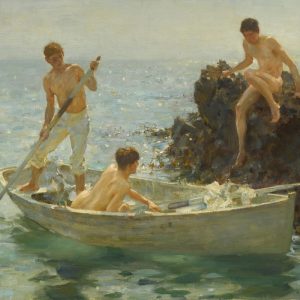
Tuke’s art is distinguished by its sensitivity to light, color, and natural atmosphere. Working primarily en plein air, he captured the fleeting qualities of sunlight on water and skin. His male nude paintings, a hallmark of his oeuvre, were typically presented in relaxed maritime settings—boys swimming, sailing, or reclining on the shore—without overt eroticism.
In the 1880s, Tuke experimented with mythological contexts for the nude, but by the 1890s, he shifted toward naturalistic depictions of local life. Works such as August Blue (1893–94, Tate Britain) and The Bathers (1888, Leeds Art Gallery) demonstrate his mature Impressionist style.
Alongside figure painting, Tuke was a skilled maritime artist, producing detailed watercolors and oils of sailing ships. His deep familiarity with nautical life allowed him to paint vessels with precision and authenticity.
Recognition and Career
Tuke exhibited at the Royal Academy from the 1880s onward, gaining increasing recognition. In 1900, he was elected an Associate of the Royal Academy, and in 1914, he became a full Academician. His paintings were acquired by major institutions, including the Tate Gallery and Leeds Art Gallery.
He maintained a studio in London for portrait commissions, painting notable sitters such as soldier and writer T.E. Lawrence. His reputation as a portraitist broadened his clientele beyond Cornwall, while his landscapes and maritime scenes appealed to collectors in Britain and abroad.
Tuke’s success allowed him to travel extensively, painting in France, Italy, and the West Indies. His connections to both the London art world and the Cornish artistic community reinforced his standing in British art.
Later Years and Death
In his later years, Tuke’s health declined, though he continued to work steadily. He remained deeply connected to Falmouth, where he was an active figure in the local art scene and a respected member of the Royal Cornwall Polytechnic Society.
Tuke died in Falmouth in 1929 and was buried nearby. He left behind a detailed artist’s register documenting over 1,300 works, along with diaries that record aspects of his personal and professional life.
Legacy
Following his death, Tuke’s reputation waned, as tastes in British painting shifted away from his subjects. In the 1970s, his work experienced a revival, particularly within the gay community, where his depictions of male beauty found new appreciation. However, beyond this cultural reassessment, his paintings have also been reevaluated for their Impressionist qualities and maritime artistry.
Today, Tuke is regarded as an important British Impressionist, celebrated for his mastery of light, color, and naturalism. Major works are held in public collections, notably Tate Britain and Leeds Art Gallery. The Royal Cornwall Polytechnic Society possesses the largest public collection of his paintings. In Falmouth, his legacy is honored through commemorations such as the naming of student residences at University College Falmouth. His art continues to resonate for its technical skill, atmospheric beauty, and timeless evocation of the sea.
Mostrando el único resultado
-
The Bathing Cove
$356.00 – $615.00Price range: $356.00 through $615.00 Seleccionar opciones Este producto tiene múltiples variantes. Las opciones se pueden elegir en la página de producto