
Onderdonk
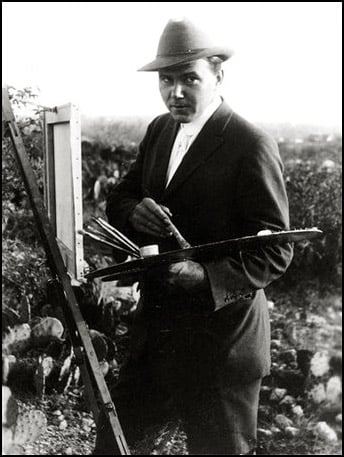
Summary of Julian Onderdonk
Julian Onderdonk (1882–1922), often called the “Father of Texas Painting,” was one of America’s most celebrated regional Impressionist painters. His luminous depictions of the Texas Hill Country—especially his celebrated bluebonnet fields—brought the landscapes of his native state to national prominence. Onderdonk’s skillful plein-air technique captured the fleeting qualities of light, color, and atmosphere, producing works of remarkable vitality and beauty. Today, his paintings are held in major museum collections, including the Dallas Museum of Art, and continue to command significant attention among collectors and art historians.
Childhood and Early Life
Robert Julian Onderdonk was born on July 30, 1882, in San Antonio, Texas, to Robert Jenkins Onderdonk, a painter and respected art instructor, and Emily Wesley Rogers (Gould) Onderdonk. Raised in a household steeped in art, Julian developed an early fascination with color, light, and composition. His sister Eleanor Onderdonk would later become a notable artist, sculptor, and curator, further cementing the family’s artistic legacy. His father served as his first teacher, guiding his early development as a draftsman and painter.
In the late 1890s, Onderdonk attended the West Texas Military Academy (now TMI Episcopal), where he also taught art classes to help finance his tuition. In 1900, at just eighteen, he took a position as art instructor at the Laurel Heights School. His exceptional promise as a landscape painter was clear, but it was evident that advanced study in a larger artistic center would be essential to refine his style.
Education and Training
In 1901, with the financial assistance of San Antonio banker G. Bedell Moore, Onderdonk traveled to New York to study at the Art Students League. There, he trained under Kenyon Cox and later Frank Vincent DuMond. That same summer, he attended William Merritt Chase’s Shinnecock Hills Summer School of Art in Southampton, Long Island. Chase—who had previously taught Robert Jenkins Onderdonk—encouraged Julian’s plein-air practice, cultivating his sensitivity to natural light and atmospheric effects. Onderdonk may also have studied briefly with Robert Henri, further broadening his stylistic range.
Career in New York
Onderdonk married Gertrude Shipman, a New Yorker, on June 18, 1902. The couple had two children: Adrienne (born in New York in 1903) and Robert (born in San Antonio in 1909). Despite his training, Onderdonk faced financial challenges in New York. In 1904, he and his family moved to Staten Island, where he briefly ran the Onderdonk School of Art. Around this time, he entered into a business arrangement with art dealer Charles E. Tunison, producing landscapes for commercial sale, often signing them with pseudonyms such as Chas. Turner, Chase Turner, Elbert H. Turner, and Roberto Vásquez.
These years, from 1904 to 1909, were highly productive. Onderdonk’s New York paintings, only later identified and attributed to him, expanded his reputation beyond Texas and revealed the breadth of his skill as a painter of varied landscapes. In 1906, he also began organizing art exhibitions for the Texas State Fair in Dallas, a seasonal position that kept his ties to his home state strong.
Return to Texas and Artistic Maturity
In November 1909, Onderdonk returned to San Antonio with his family, moving into his parents’ home at 128 W. French Place. Back in the Texas Hill Country, Onderdonk fully embraced plein-air painting, capturing the region’s rolling terrain, changing skies, and wildflower fields. By 1911, he had begun focusing on bluebonnets—a subject that would become his hallmark.
His best-known works from this period include Sunlight and Shadow (1910), Spring Morning (1911), Bluebonnet Field(1912), Blue Bonnets in Texas (1915), Road to the Hills (1918), and Cliffs on the Guadalupe River (1921). These paintings, with their vibrant color and atmospheric depth, established him as the premier interpreter of the Texas landscape.
Later Career and Death
Following the death of his father in 1917, Onderdonk became an influential figure in San Antonio’s art scene, participating in civic events, presenting awards, and supporting the city’s artistic growth. His bluebonnet paintings became highly sought after and were reproduced for sale in department stores such as Joske’s, making his imagery widely recognizable.
In 1922, at the height of his success, Onderdonk completed Dawn in the Hills and Autumn Tapestry, both exhibited at the National Academy of Design in New York. Tragically, later that year, he died suddenly of acute intestinal obstruction and appendicitis on October 27, 1922. He was buried in the Alamo Masonic Cemetery in San Antonio.
Legacy
Onderdonk’s impact on Texas art was profound. His sister Eleanor, as the first curator of the Witte Memorial Museum, helped preserve and promote his work. His paintings are now featured in prominent museum collections, including the Dallas Museum of Art, the San Antonio Museum of Art, and the Witte Museum. His reputation reached even the highest levels of American public life—President George W. Bush displayed several of his works in the Oval Office.
Today, Julian Onderdonk is celebrated as one of the most important regional painters of the American Impressionist movement. His luminous landscapes, especially his bluebonnet scenes, remain enduring symbols of Texas’ natural beauty, continuing to inspire admiration from collectors, scholars, and art enthusiasts around the world.
Mostrando el único resultado
-

Old Live Oak Tree and Bluebonnets on the West Texas
$276.00 – $477.00Price range: $276.00 through $477.00 Seleccionar opciones Este producto tiene múltiples variantes. Las opciones se pueden elegir en la página de producto