
Potthast
Summary
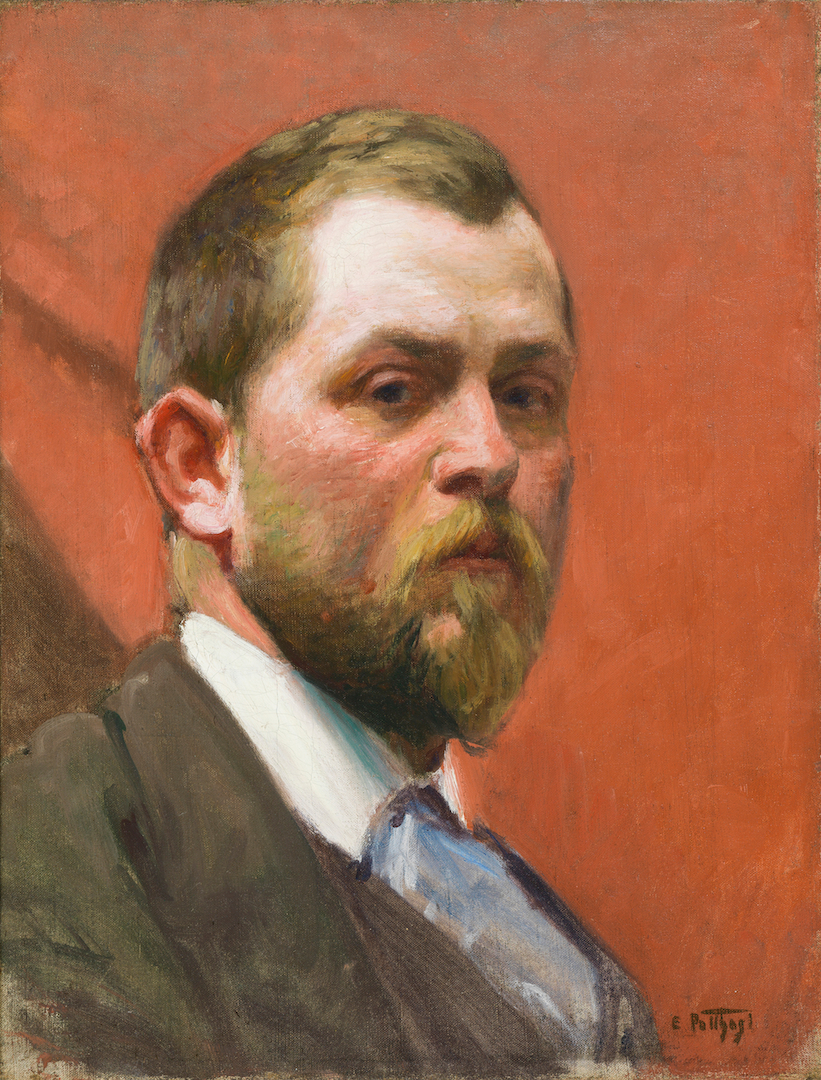
Edward Henry Potthast (June 10, 1857 – March 9, 1927) was a distinguished American Impressionist painter, renowned for his bright, sunlit depictions of leisure scenes in Central Park and the beaches of New York and New England. Born into a working-class family in Cincinnati, Ohio, Potthast initially pursued a career as a lithographer before fully dedicating himself to painting. His work showcases a harmonious blend of the subdued tonal contrasts of the Munich School with the vibrant light and color of French Impressionism, resulting in joyful and lively scenes of everyday life and recreation.
Early Life and Education
Potthast was born in Cincinnati to Henry Ignatz Potthast, a skilled cabinetmaker, and Bernadine Scheiffers, an office clerk and hat seller. Raised in a modest household, he showed artistic promise early on. By the age of thirteen, he was already exhibiting his work at the McMicken School of Design’s second annual exhibition. In 1874, he studied under the American painter Thomas S. Noble, known for his historical and genre paintings. Simultaneously, Potthast trained as a lithographer with Ehrgott Krebs Company, a firm specializing in printmaking, where he honed the technical skills that would later support his painting career.
In 1879, Potthast began working at Strowbridge Lithographing Company, further deepening his mastery of lithography. However, his artistic ambitions led him overseas in the early 1880s. In 1882, he traveled to Antwerp, Belgium, alongside fellow American artists Joseph Henry Sharp and Charles Haider to study under the renowned painter Charles Verlat. Following Antwerp, Potthast moved to Munich, a major art center at the time, where he studied with celebrated artists Nicolas Gysis and Ludwig von Loefftz. There is also speculation that he may have studied briefly with Carl Marr. These years in Europe proved formative; Potthast absorbed the disciplined techniques and tonal qualities of the Munich School, which emphasized naturalistic representation and strong contrasts.
Returning to Cincinnati in 1885, he resumed his lithographic work while attending evening classes at the Art Academy of Cincinnati under Thomas S. Noble. A few years later, Potthast felt the pull of Europe once again, drawn by the artistic hubs of Fontainebleau Forest, Barbizon, and Grez in France. Here, he encountered the works of the French Impressionists, including Claude Monet and Pierre-Auguste Renoir. Inspired by Robert W. Vonnoh, an American Impressionist who emphasized vibrant color and light effects, Potthast gradually adopted an Impressionist palette and brushwork style. Between 1889 and 1891, he exhibited at the prestigious Paris Salon and studied under Fernand Cormon, famed for his paintings of prehistoric subjects and influential role as a teacher to many future masters.
Career in the United States
After returning to Cincinnati, Potthast continued his lithography career but also increasingly focused on painting and exhibiting his works. His participation in local exhibitions at institutions like the Cincinnati Art Museum helped establish his regional reputation. In 1896, seeking broader opportunities, Potthast relocated to New York City, which was rapidly becoming the cultural heart of America’s art world.
In New York, he worked as an illustrator for prominent magazines such as Harper’s, Scribner’s, and Century. These commissions not only provided financial support but also sharpened his ability to capture scenes of everyday life with clarity and immediacy. His talent was recognized when he was elected an associate member of the National Academy of Design in 1899 and then a full academician in 1906, milestones that underscored his growing stature.
Photographic evidence suggests that Potthast may have traveled back to Europe around 1905, likely to stay connected with the evolving artistic currents there. By 1908, he committed himself entirely to painting and established a studio in the Gainsborough Building at 222 West 59th Street in Manhattan. From this vantage point, Potthast painted views looking out toward Central Park, capturing the park’s sunlit crowds with his signature warmth and immediacy.
In 1910, Potthast joined a notable excursion to the Grand Canyon, sponsored by the Atchison, Topeka and Santa Fe Railway. The group included artists such as Thomas Moran and Elliot Daingerfield. This trip deepened Potthast’s engagement with American landscapes. He also traveled to the Canadian Rockies, further expanding his repertoire of natural settings.
During World War I, Potthast produced paintings of floating targets used in naval training exercises, demonstrating his ability to respond to contemporary events while maintaining his characteristic style. Throughout his career, he was an active member of numerous artistic organizations, including the Society of American Artists, the National Arts Club, the Lotus Club, the Salmagundi Club, and the American Watercolor Society. He garnered many awards and medals, reflecting his peers’ respect and the public’s appreciation.
Style and Influence
Potthast’s work uniquely blends the strong contrasts and tonal discipline of the Munich School with the bright, lively brushwork and colors of Impressionism. His paintings typically depict leisurely activities, focusing on sun-drenched park scenes, beachgoers, children playing, and quiet moments of rest. His brushstrokes are loose yet controlled, giving his works a spontaneous and fresh feeling while maintaining clarity.
His approach was rooted in observation but imbued with an atmosphere of joy and warmth, capturing the fleeting effects of sunlight and the vitality of urban and coastal life. Unlike some contemporaries who ventured into abstraction or overt symbolism, Potthast remained a dedicated Impressionist focused on light, color, and everyday beauty. His influence helped popularize Impressionism in America and inspired many artists interested in portraying modern life’s pleasures.
Death and Legacy
Potthast died suddenly of a heart attack in his New York studio on March 9, 1927. Later that year, a retrospective exhibition of his work was held at the Traxel Galleries in Cincinnati, celebrating his contributions to American art. In a move to preserve the quality of his artistic legacy, Potthast’s heirs destroyed sketches, unfinished works, and unsigned paintings they deemed not reflective of his mature style, ensuring that only his best work would be circulated.
Today, Edward Henry Potthast’s paintings are part of important public and private collections across the United States. His works are featured in the Orlando Museum of Art, the Brooklyn Museum, Cape Ann Museum, Delaware Art Museum, University of Michigan Museum of Art, Phoenix Art Museum, Nasher Museum of Art, and the Virginia Museum of Fine Arts, among others. Potthast’s luminous scenes continue to delight viewers, offering a timeless glimpse of American leisure life through the eyes of a masterful Impressionist.
Mostrando el único resultado
-
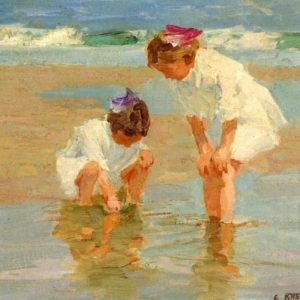
Girls Playing in Surf
$276.00 – $477.00Price range: $276.00 through $477.00 Seleccionar opciones Este producto tiene múltiples variantes. Las opciones se pueden elegir en la página de producto