
Rousseau
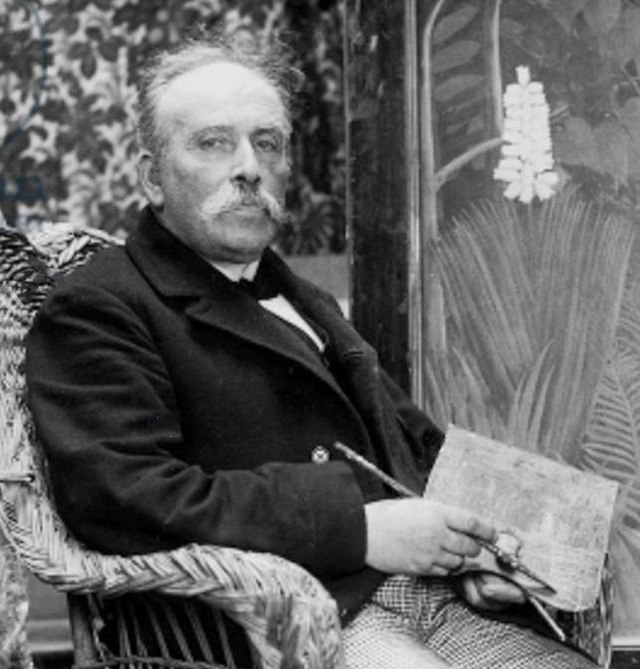
Summary
Henri Julien Félix Rousseau (1844–1910) stands as one of the most distinctive figures in modern art, celebrated for his so-called “naïve” style that defied academic convention. A self-taught painter who worked for years as a Paris customs official, Rousseau pursued art with determination, creating works that combined simplified forms, vivid colors, and dreamlike imagery. Though he faced rejection from the official Salon, he became a regular exhibitor at the Salon des Indépendants, where his enigmatic jungle scenes—painted from imagination and botanical observation rather than travel—earned admiration from the avant-garde. Artists such as Picasso, Apollinaire, and the Surrealists later championed his originality. Today, Rousseau’s paintings, from Tiger in a Tropical Storm (Surprised!) to The Dream, are recognized for their poetic vision, placing him among the most influential outsiders of early modernism.
Early Life
Henri Julien Félix Rousseau was born in the provincial town of Laval, France, to a modest family. His father, a metalsmith, faced ongoing financial hardship that eventually resulted in the loss of the family home in 1851. This event marked a shift in the family’s circumstances and led to Rousseau’s placement as a boarding student at the Laval High School. While he was considered an average pupil, he displayed a particular aptitude for drawing and music, winning small distinctions in these areas.
In 1861, the Rousseau family relocated to Angers. Henri found work as a clerk for a local bailiff. Although he initially avoided military service through the draft, he ultimately enlisted in the 51st Infantry Regiment after a dispute with his employer. His years of military service were spent in France, though Rousseau later embellished tales of his past, claiming adventures in Mexico during the French campaign there. These fictional accounts would later become part of the mythos surrounding his jungle paintings.
Career Beginnings
After his service, Rousseau married Clémence Boitard in 1868. The couple endured personal loss, as only their daughter Julia survived to adulthood. Seeking steady work, Rousseau accepted a position with the Paris customs service. His role was relatively undemanding, providing time for the pursuit of artistic interests. It was during these years that Rousseau began sketching in earnest.
A self-taught painter, Rousseau admired academic artists such as Jean-Léon Gérôme and William-Adolphe Bouguereau, aspiring to official recognition from the Académie des Beaux-Arts. Though he was consistently rejected by the official Salon, Rousseau found an alternative exhibition venue in the Salon des Indépendants, where he began showing his work in 1885. Early paintings, such as Carnival Evening (1886), already demonstrated the enigmatic, dreamlike qualities that would define his mature style. In 1891, Surprised! Tiger in a Tropical Storm became the first of his celebrated jungle works, inspired not by travels abroad but by visits to the Jardin des Plantes and the Muséum National d’Histoire Naturelle in Paris.
Mature Period
In 1893, Rousseau retired from the customs office to paint full-time. His War (1894), an ambitious allegorical scene, marked a turning point in his career, garnering a rare positive review in the Mercure de France. The painting also attracted the attention of writer Alfred Jarry, who became a supporter.
Throughout the 1890s, Rousseau sought larger commissions, including projects to decorate the town halls of Vincennes and Asnières, though these efforts were unsuccessful. Despite setbacks, his jungle compositions began to draw notice from younger avant-garde artists. Works such as Scouts Attacked by a Tiger (1904) received attention at the Indépendants, reintroducing his work to the public.
Around this time, Rousseau entered the artistic circles of Georges Braque, Guillaume Apollinaire, Robert Delaunay, and Pablo Picasso. In 1906, he met the German art dealer Wilhelm Uhde, who would become a key promoter of his work. Rousseau’s career, however, was marred by personal financial difficulties. In 1907, he was briefly imprisoned for bank fraud, an incident that provided insight into his character through letters he wrote to the court appealing for clemency.
Later Years and Death
In 1908, Uhde organized Rousseau’s first solo exhibition, which failed commercially but reinforced his status among the avant-garde. That same year, Picasso discovered Rousseau’s Portrait of a Woman (1895) in a secondhand shop. To celebrate the purchase, Picasso hosted a now-famous banquet in Rousseau’s honor, attended by leading artists and writers.
Despite such moments of recognition, Rousseau continued to live modestly. In 1910, he died in Paris from complications of an infected leg wound. His funeral was a modest affair, attended by a small group of loyal friends.
Legacy
In the years following his death, Rousseau’s work gained increasing recognition. A memorial exhibition at the Salon des Indépendants in 1911, organized by Delaunay, and the first biography by Uhde, helped solidify his reputation. Wassily Kandinsky included reproductions of Rousseau’s paintings in the Blaue Reiter Almanac (1912), acknowledging the profound influence of his art.
Rousseau’s so-called naïve style, once dismissed by critics, became celebrated for its originality. His simplified forms, vivid colors, and imaginative compositions aligned with the “primitivism” embraced by artists such as Picasso and the Surrealists. André Breton hailed Rousseau as a precursor to Surrealism, noting the dreamlike clarity of works like The Dream (1910).
Today, Henri Rousseau is regarded as one of the most distinctive figures of modern art—a self-taught painter whose unconventional vision transformed simplicity into a poetic and enduring legacy.
Mostrando el único resultado
-

The Dream
$780.00 – $4,880.00Price range: $780.00 through $4,880.00 Seleccionar opciones Este producto tiene múltiples variantes. Las opciones se pueden elegir en la página de producto