
Seurat

Summary
Georges Seurat (1859–1891) stands as the pioneering force behind Neo-Impressionism and the invention of Pointillism, also known as Divisionism—a painting technique characterized by the use of tiny, precise dots or strokes of pure color placed side by side, which blend optically in the viewer’s eye to create luminous surfaces. Seurat’s artistic innovations were grounded in scientific theories of color and vision, but his work also drew inspiration from classical art, Gothic aesthetics, and popular graphic posters, reflecting a unique blend of intellectual rigor and artistic grace. His paintings, especially Sunday Afternoon on the Island of La Grande Jatte (1884–86), have become iconic representations of modern art’s beginnings. Despite dying at the young age of 31, Seurat’s relatively small but highly influential body of work profoundly shaped the trajectory of late 19th- and early 20th-century painting, inspiring contemporaries and later avant-garde movements alike.
Early Life and Childhood
Georges-Pierre Seurat was born on December 2, 1859, in Paris, the youngest of three children in a comfortably middle-class family. His father, Chrysostome-Antoine Seurat, was a retired bailiff who had accumulated some wealth by the time Georges was born. His mother, Ernestine Faivre, came from a prosperous family with artistic leanings, having produced several sculptors. The family lived in the Paris suburb of Le Raincy. During the tumultuous years of the Franco-Prussian War (1870–71) and the subsequent Paris Commune rebellion, they relocated temporarily to Fontainebleau. From an early age, Seurat showed a keen interest in art. He was encouraged by his maternal uncle, Paul Haumonté, a textile dealer and amateur painter. These informal early lessons nurtured young Seurat’s developing talent and fostered his appreciation for drawing and painting.
Formal Training and Early Influences
Around 1875, Seurat entered the local municipal art school where he studied sculpture under Justin Lequien. Here he formed a friendship with Edmond Aman-Jean, who would become a significant figure in his artistic life. Soon after, Seurat enrolled in the École des Beaux-Arts in Paris, studying under Henri Lehmann, a disciple of the Neoclassical master Jean-Auguste-Dominique Ingres.
At the École, from 1878 to 1879, Seurat’s training focused intensively on drawing, composition, and classical techniques. He spent countless hours sketching from plaster casts and live models, cultivating a disciplined and rigorous approach to form.
Outside formal education, Seurat devoted himself to studying great masters by copying works of Holbein, Raphael, and Poussin. He also sought guidance from Pierre Puvis de Chavannes, who specialized in large allegorical murals, further enriching Seurat’s understanding of classical and symbolic imagery.
Crucially, Seurat immersed himself in the study of color theory and optics, fueled by the writings of Michel-Eugène Chevreul and Charles Blanc, who emphasized the scientific principles behind color harmony and contrast. Chevreul’s discovery—that placing complementary colors side by side creates the perception of a new color—became foundational to Seurat’s future Divisionist technique.
His first exposure to Impressionism came in 1879 when he visited the Fourth Impressionist Exhibition, encountering works by Claude Monet and Camille Pissarro. Although inspired by their focus on light and color, Seurat sought a more structured and scientific method, contrasting with the Impressionists’ spontaneity.
The Birth of Neo-Impressionism and Major Works
Between 1881 and 1884, Seurat began translating his color theories into paintings. His first major work, Bathers at Asnières (1884), depicts a group of working-class Parisians relaxing by the Seine River. The painting is notable for its balance between naturalistic detail and a carefully constructed composition that utilizes a brushstroke technique called balayé—a cross-hatching style—which he later enhanced with precise dots of contrasting color.
Rejected by the official Salon, Seurat exhibited Bathers at the newly formed Société des Artistes Indépendants, alongside artists like Paul Signac, who quickly became a close friend and follower of Seurat’s style.
Seurat’s masterpiece, Sunday Afternoon on the Island of La Grande Jatte (1884–86), took two years to complete. The massive canvas, portraying Parisians enjoying leisure time along the Seine, epitomizes his Pointillist technique—tiny dots of pure color applied meticulously across the surface. When viewed from a distance, these dots fuse optically to produce vibrant, shimmering light effects. The painting’s complex arrangement also explores themes of modern urban life and class distinctions. Exhibited at the Eighth Impressionist Exhibition in 1886, La Grande Jatte firmly established Seurat as the leader of Neo-Impressionism and attracted international attention.
Later Years and Evolution
Following La Grande Jatte, Seurat continued to refine his Pointillist technique, painting nocturnal scenes and coastal landscapes, often spending summers on the Normandy coast. His later works, such as The Circus (unfinished), reveal a darker, more muted palette and a focus on psychological depth and symbolism, reflecting his interest in the Symbolist movement.
In 1889, Seurat traveled to Belgium, exhibiting at the Salon des Vingt, further broadening his reputation. Around this time, he began a private relationship with Madeleine Knobloch, a young model, with whom he fathered a son. His only known portrait of her, Young Woman Powdering Herself, was shown at the 1890 Salon des Indépendants.
Death and Legacy
Tragically, Seurat’s life was cut short when he suddenly fell ill in March 1891 and died at age 31. His son died shortly thereafter, and both are buried in Père-Lachaise Cemetery in Paris.
Seurat left behind a relatively small oeuvre—seven monumental paintings, hundreds of drawings, and around 40 smaller paintings—but his legacy is immense. His pioneering use of scientific color theory and methodical brushwork marked a decisive break from Impressionism and laid the groundwork for modern movements like Fauvism and Cubism. Neo-Impressionism brought a new awareness of the decorative and structural qualities of painting, influencing generations of artists interested in light, color, and abstraction.
Artists such as Paul Signac, Vincent van Gogh, and Bridget Riley, among others, have acknowledged Seurat’s profound impact on their work. Today, Seurat remains celebrated as a visionary who bridged the 19th-century Impressionist movement and the burgeoning avant-garde of the 20th century.
Mostrando el único resultado
-
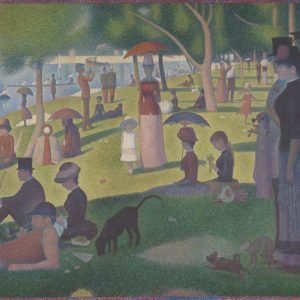
A Sunday Afternoon on the Island of la Grande Jatte
$544.00 – $3,400.00Price range: $544.00 through $3,400.00 Seleccionar opciones Este producto tiene múltiples variantes. Las opciones se pueden elegir en la página de producto