Summary
Vincent van Gogh (1853-1890) is one of the most famous and influential figures in the history of Western art. A Dutch Post-Impressionist painter, he created around 2,100 artworks—including roughly 860 oil paintings—in just over a decade. His work, notable for its emotional honesty, bold colors, and expressive brushwork, was not commercially successful during his lifetime, and he famously sold only one painting. After years of struggle with poverty and severe mental illness, he died by suicide at the age of 37. His posthumous fame grew exponentially, largely thanks to the efforts of his brother Theo’s widow, Johanna. Today, his paintings are among the world’s most recognizable and expensive works of art, and his tragic life story has cemented his legacy as the quintessential tortured artist whose genius was not recognized until after his death.
Early Life and Artistic Beginnings
Born in the Netherlands to a minister and the daughter of a bookseller, Vincent van Gogh was the second of six children. As a youth, he was moody and showed little artistic talent, though he did well with languages before abruptly quitting his formal education in 1868. The following year, he began an apprenticeship at the Goupil & Cie art dealership, where he worked for nearly a decade in various branches, including The Hague, London, and Paris. It was during this time he began a lifelong correspondence with his younger brother, Theo. Over time, van Gogh grew increasingly religious and withdrawn, leading to his dismissal. He then attempted a spiritual career as a preacher in a Belgian mining community, but his extreme devotion and practice of giving away all his possessions led church authorities to let him go. In 1880, at the age of 27, he resolved to become an artist, viewing it as a new spiritual calling, and began to receive crucial financial support from Theo.
Artistic Development in the Netherlands
Forced by poverty to move back in with his parents, van Gogh taught himself to draw and paint. After a tumultuous period marked by an unrequited love for his cousin and resulting family tensions, he moved to The Hague with Theo’s support. There, he studied with the artist Anton Mauve and was deeply influenced by the work of Jean-François Millet, whose focus on rural laborers resonated with him. During this time, he entered a controversial relationship with a destitute prostitute named Sien, who modeled for many of his works before their relationship ended. By 1884, he had settled in Nuenen, where he focused on painting peasant life. This culminated in his first major work, The Potato Eaters (1885), a piece defined by a dark, earthy palette that stood in stark contrast to the bright colors of the Impressionist movement then emerging in Paris.
Mature Period in Paris and Arles
In 1886, van Gogh moved to Paris to live with Theo, immersing himself in the city’s vibrant art scene. He studied with Fernand Cormon and was introduced to Impressionists like Monet and Pissarro, leading him to adopt a much lighter and more colorful palette. He also became fascinated with Japanese prints, whose style heavily influenced his work. Eager for a new environment, he moved to Arles in the south of France in 1888, where he hoped to establish an artists’ colony in his “Yellow House.” He invited Paul Gauguin to join him, and together they developed a bold style that used color to express emotion rather than objective reality. However, van Gogh’s mental health began to severely decline. Their partnership ended in a famous confrontation where a distraught van Gogh mutilated his own left ear.
Final Years and Death
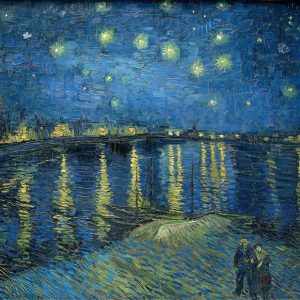
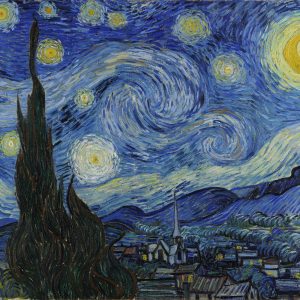
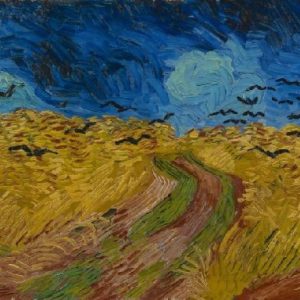
Following his breakdown, van Gogh voluntarily admitted himself to a psychiatric institution in Saint-Rémy in May 1889. Despite his continued struggles, this period was incredibly prolific; he produced over 100 paintings in a year, including his most iconic masterpiece, Starry Night. After his release in 1890, he moved to Auvers-sur-Oise to be under the care of Dr. Paul Gachet. He painted furiously, averaging nearly one work a day. However, after learning of his brother Theo’s financial troubles, he fell into a deep depression. On July 27, 1890, he shot himself in the chest in a nearby wheat field and died two days later, with Theo by his side. His reported last words were, “The sadness will last forever.”
Legacy
Though his career spanned only a decade and he was virtually unknown in his lifetime, Vincent van Gogh’s impact on modern art is immense. His emotive use of color and gestural application of paint directly influenced major movements, such as Fauvism and German Expressionism, and prefigured Abstract Expressionism. His life story has been the subject of numerous books and films, solidifying his mythic status. Today, he is universally regarded as one of the greatest artists in history, and his works continue to captivate audiences worldwide.