
Zorn
Summary
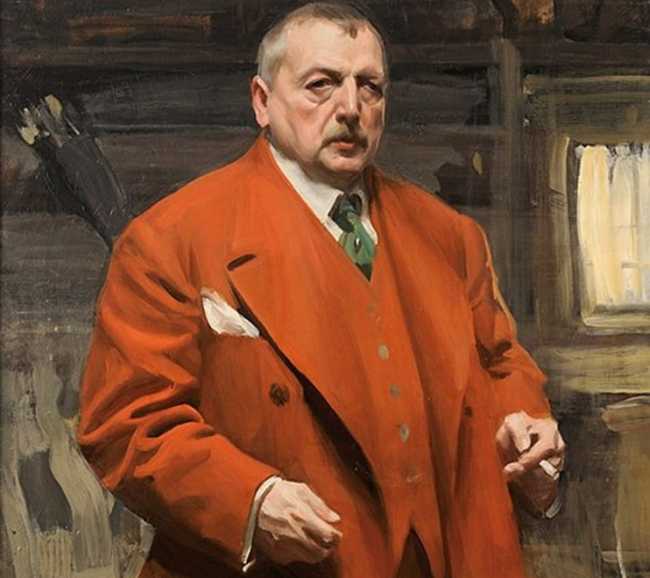
Anders Leonard Zorn (1860–1920) was a Swedish painter, sculptor, and printmaker celebrated for his virtuosity in portraiture, his atmospheric depictions of Swedish rural life, and his technical mastery in multiple media. Renowned as one of the leading artists of his generation, Zorn gained international acclaim for his portraits, which attracted commissions from prominent cultural figures and political leaders, including three U.S. presidents. His works in oil, watercolor, and etching combine naturalistic precision with an Impressionist approach to light, particularly in his treatment of outdoor scenes and the human figure.
Zorn’s artistic career was marked by extensive travel, with extended stays in London, Paris, Spain, and the United States, where his cosmopolitan presence secured him a place among the most sought-after portraitists of the late 19th and early 20th centuries. His paintings, especially his celebrated nudes and genre scenes, reveal influences from artists such as Velázquez, Sargent, and Sorolla, while remaining distinctly his own. Today, he is regarded as one of Sweden’s most important cultural figures and a central name in turn-of-the-century European art.
Early Life and Career Development
Born in Utmeland, Mora, Sweden, on February 18, 1860, Zorn was the son of a local farmwoman, Grudd Anna Andersdotter, and a German brewer, Leonard Zorn. Raised primarily by his grandparents in rural Dalecarlia after the death of his father, he demonstrated artistic talent from an early age. In 1872 he entered school in Enköping, and by 1875 he was enrolled at the Royal Swedish Academy of Fine Arts in Stockholm. Initially focused on sculpture, he later shifted his attention to watercolor painting, a medium in which he quickly excelled.
In 1880, Zorn completed his studies and became engaged to Emma Lamm, a woman from a wealthy merchant family who would play a vital role in his professional and social advancement. The following year, he began a cosmopolitan career that took him to London, Paris, and Spain. His first visit to Spain in 1881–1882, in the company of Ernst Josephson, introduced him to the works of Velázquez at the Museo del Prado, sparking a lifelong admiration that would inform his approach to tonal harmony and brushwork. He returned to Madrid in 1884 to paint high-society portraits, including Portrait of Cristina Morphy, which was exhibited at the National Exhibition of Fine Arts that year.
By the late 1880s, Zorn had transitioned to oil painting, influenced by Whistler, Sargent, and Albert Besnard. His mastery of light, water, and the nude figure was evident in works such as Sommarnöje (1886) and Les Baigneuses (1888). Settling for periods in Paris, he became a fixture in international exhibitions, earning honors such as the Légion d’Honneur in 1889. His success as a portraitist extended to the United States, where he painted Grover Cleveland (1899), Theodore Roosevelt (1905), and William Taft (1911).
Legacy
In 1896, Zorn and Emma returned to Mora, where he devoted increasing attention to Swedish culture, traditions, and rural festivities. Works such as Midsommardans (1897) capture the spirit of Dalecarlian life with the same sensitivity he applied to cosmopolitan subjects. His oil paintings combined the direct realism of his Scandinavian heritage with Impressionist influences, while his 289 recorded etchings, inspired in part by Rembrandt, secured his reputation as a master printmaker. His sculptural works, ranging from small bronzes to public monuments like the statue of Gustav Vasa (1903), further demonstrated his versatility.
Zorn’s reputation remained strong during his lifetime, and he was a member of the Berlin Secession. After he died in Stockholm on August 22, 1920, his widow established the Zorn Museum in Mora (1939), housing his paintings, prints, sculptures, and personal collection of Spanish works, including pieces attributed to Velázquez’s circle and the school of El Greco.
His art remains in major museums such as the National Museum in Stockholm, the Musée d’Orsay, and the Metropolitan Museum of Art. Though some works, like Hins Anders (1904), have been lost or stolen, his legacy endures as a central figure in Swedish art and as one of the most accomplished portraitists and genre painters of his era.
Mostrando el único resultado
-
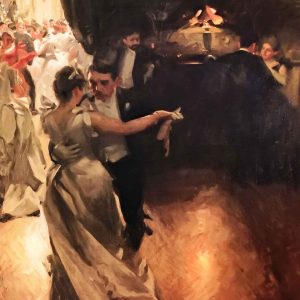
The Waltz
$316.00 – $1,668.00Price range: $316.00 through $1,668.00 Seleccionar opciones Este producto tiene múltiples variantes. Las opciones se pueden elegir en la página de producto