
Marmottan Monet; France
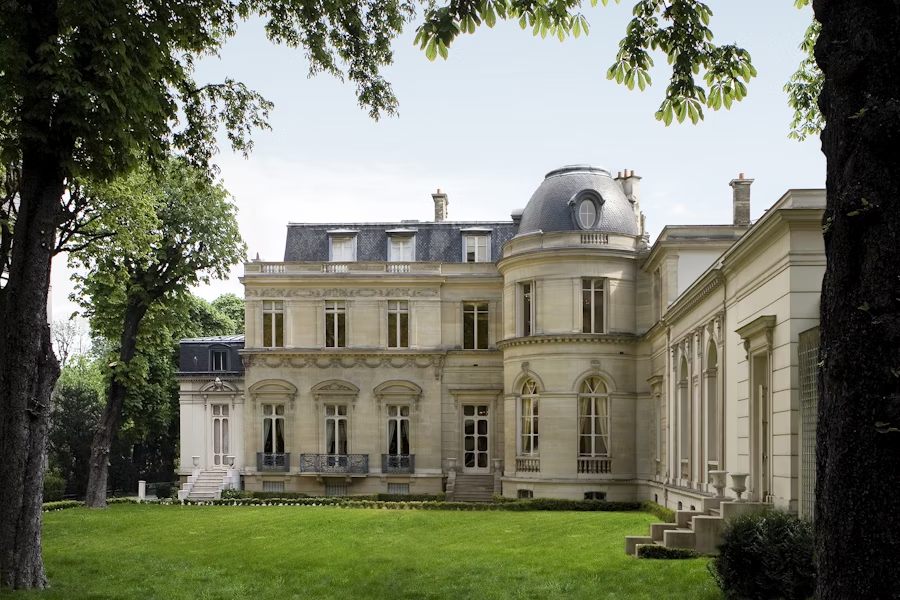
The Musée Marmottan Monet is a Parisian institution of remarkable transformation, possessing a dual identity forged by two distinct and opposing artistic passions. It began as the elegant mansion of Paul Marmottan, a scholar who dedicated his home to the art of the Napoleonic Empire. Through a series of unexpected bequests, it was later reborn as the world’s most important repository for the works of Claude Monet, housing the iconic painting that gave Impressionism its name, Impression, Sunrise.
From Ducal Estate to a Collector’s Home
The museum’s building began its life as a hunting lodge on the grounds of the former Château de la Muette. The specific plot of land was acquired in 1863 by the Duke of Valmy, who built a private mansion there. After his death, the property was sold in 1882 to Jules Marmottan, an industrialist and director of a major mining company. An avid art lover, Jules acquired a collection of medieval and pre-Renaissance paintings, statuettes, and tapestries from Italy, Flanders, and Germany. He purchased the Parisian mansion specifically to house these works, and upon his death in 1883, he left the home and its collections to his only son, Paul.
Paul Marmottan’s Imperial Passion
Paul Marmottan, the museum’s founder, abandoned a promising career in public administration to dedicate his life to the study of art and history from the French Consular and Imperial periods (1789-1830). He became a renowned scholar and author, and his academic research directly inspired his collecting. He amassed an authoritative collection of paintings, sculptures, and furniture from the Napoleonic era, redecorating his home in a lavish Empire style to create a perfect setting for his acquisitions. Left without heirs, Paul Marmottan bequeathed his mansion and its entire collection to the Académie des Beaux-Arts to preserve it as a museum. The Musée Marmottan officially opened to the public on June 21, 1934.
A Radical Transformation: The Arrival of Impressionism
The museum’s original identity was fundamentally reshaped by the arrival of an art movement its founder had personally condemned. Paul Marmottan had been unequivocal in his dislike for Impressionism, and the Académie des Beaux-Arts had famously rejected its artists from the official Salons. This situation changed radically between 1940 and 1947 with a donation from Victorine Donop de Monchy. She gifted the museum the collection she had inherited from her father, Dr. Georges de Bellio, who had been one of the very first patrons of Monet and his circle. This gift included Monet’s Impression, Sunrise. The acceptance of this work, which had inspired the pejorative term “Impressionist,” marked a historic reversal, signifying the Academy’s official recognition of the movement’s value.
The House of Monet
The museum’s conversion was fully realized in 1966 with a spectacular bequest from Michel Monet, the artist’s son and sole heir. He left his entire inheritance—over one hundred works by his father—to the Musée Marmottan. This gift included paintings by masters collected by Monet, but most importantly, it contained the world’s largest collection of works from his final years at Giverny, including a unique ensemble of large-format Water Lilies. The mansion’s salons were too small to display these monumental canvases, so a special, spacious gallery was built underground beneath the garden, opening in 1970. This bequest forever changed the institution, which was renamed the Musée Marmottan Monet in honor of its new identity as the home of the father of Impressionism.
A Legacy of Benefactors
The Monet bequest established the museum as a premier center for Impressionism, attracting other major donations. In 1993, the descendants of the artist Berthe Morisot bequeathed the most significant collection of her work in the world. Other benefactors gifted pieces by Gauguin and other masters. In 1981, a donation from the Wildenstein family established the museum as a leading center for the study of medieval and Renaissance manuscript illuminations. Through this incredible history of bequests, the intimate house-museum of an Empire enthusiast has grown into a world-renowned institution with unparalleled collections of Impressionism and beyond.
Mostrando el único resultado
-

Impression, Sunrise (Impression, Soleil Levant)
$236.00 – $408.00Price range: $236.00 through $408.00 Seleccionar opciones Este producto tiene múltiples variantes. Las opciones se pueden elegir en la página de producto