Since its founding in 1870, The Metropolitan Museum of Art has stood as one of the world’s most ambitious and expansive cultural institutions. Envisioned not merely as a repository of beautiful objects, but as a dynamic space where art could connect people across time and geography, The Met was born from a vision to bring art and art education to the American public.
Today, The Met houses over two million works of art spanning more than 5,000 years of human history, and welcomes millions of visitors annually across its two iconic locations—The Met Fifth Avenue and The Met Cloisters. From Roman sarcophagi and ancient Egyptian sculpture to American decorative arts, Islamic architecture, and contemporary photography, The Met’s collection is both encyclopedic and profoundly humanistic, reflecting the richness and diversity of global artistic expression.
Beginnings
The idea for a national art museum took root in 1866 in Paris, when American lawyer John Jay and a group of expatriates resolved to establish a cultural institution that would uplift and educate the American people. Upon his return to New York, Jay galvanized a network of civic leaders, artists, and philanthropists, culminating in the incorporation of The Met in April 1870. The Museum first opened to the public later that year in a rented townhouse on Fifth Avenue, with its first acquisition—a Roman sarcophagus—marking the beginning of a world-class collection.
By 1880, The Met moved into its permanent home on Fifth Avenue and 82nd Street, a building originally designed in the Ruskinian Gothic style by Calvert Vaux and Jacob Wrey Mould. Subsequent expansions have fully enveloped the original structure, creating a vast, architecturally layered complex that reflects the institution’s continuous growth and evolution.
Growth and Expansion
In its early decades, The Met rapidly acquired important works from European and ancient civilizations, including the renowned Cesnola Collection of Cypriot antiquities and paintings by masters like Van Dyck and Poussin. By the turn of the 20th century, the Museum had become a major player on the world stage, acquiring works by Manet, Renoir, and in 1910, becoming the first public institution to purchase a painting by Henri Matisse.
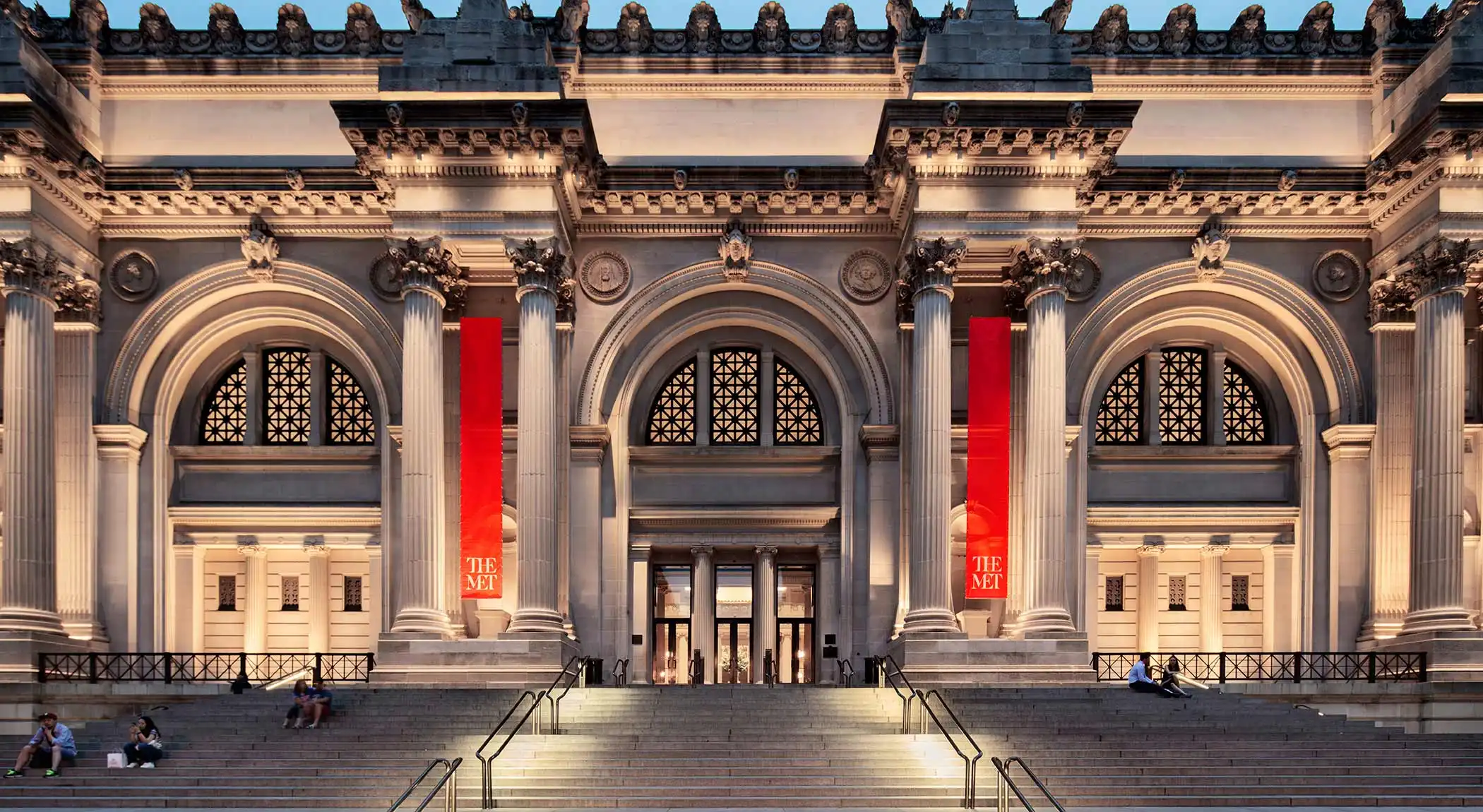
A defining moment came in 1902 with the opening of the Museum’s neoclassical Beaux-Arts façade and Great Hall, designed by founding trustee and architect Richard Morris Hunt. The structure was hailed as New York’s “palace of art,” signaling the city’s growing cultural prominence.
Throughout the 20th century, The Met’s collections expanded dramatically. The American Wing, opened in 1924 and later renovated, became the most comprehensive collection of American art in the world. In 1978, the Museum opened the Sackler Wing, home to the majestic Temple of Dendur—an Egyptian monument dating from 15 BCE—solidifying its reputation as a global center for ancient art.
The Met Cloisters and The Met Breuer
In 1938, The Met opened The Cloisters in northern Manhattan, a museum devoted entirely to the art, architecture, and gardens of medieval Europe. Set within Fort Tryon Park and constructed using elements from authentic medieval structures, The Met Cloisters provides an immersive experience for exploring the sacred and secular life of the Middle Ages.
Decades later, The Met extended its reach into modern and contemporary art with The Met Breuer, which opened in 2016 in the landmark Brutalist building designed by Marcel Breuer. While the initiative ended in 2020, The Met Breuer served as a critical step in reimagining The Met’s engagement with 20th- and 21st-century art, reinforcing the Museum’s commitment to bridging tradition and innovation.
A Living Institution
Architecturally, The Met has undergone a century-long transformation. From the Robert Lehman Wing (1975) to the Michael C. Rockefeller Wing (1982) and the Lila Acheson Wallace Wing (1987), each new space was tailored to better present art from around the world. Major renovations in the 21st century—such as the complete reinstallation of the Greek and Roman galleries and the newly conceived spaces for Korean, Islamic, and American art—have revitalized The Met’s galleries for a modern audience.
In recent years, The Met has taken active steps to recognize the complex cultural narratives that shape its collection. In 2021, the Museum installed a land acknowledgment plaque on its Fifth Avenue façade, honoring Lenapehoking, the homeland of the Lenape people.
Legacy
What began as a modest vision in the late 19th century has become a cornerstone of cultural life in New York and an essential destination for art lovers worldwide. With its unparalleled breadth, The Met offers not just a survey of artistic achievement, but a place where the threads of human creativity, conflict, spirituality, and beauty are woven together across time.
More than just a museum, The Met is a civic institution—ever evolving, ever responding to the changing world around it. Through scholarship, conservation, education, and innovation, it remains steadfast in its mission to connect all people to art, knowledge, and each other.