
Flaming June
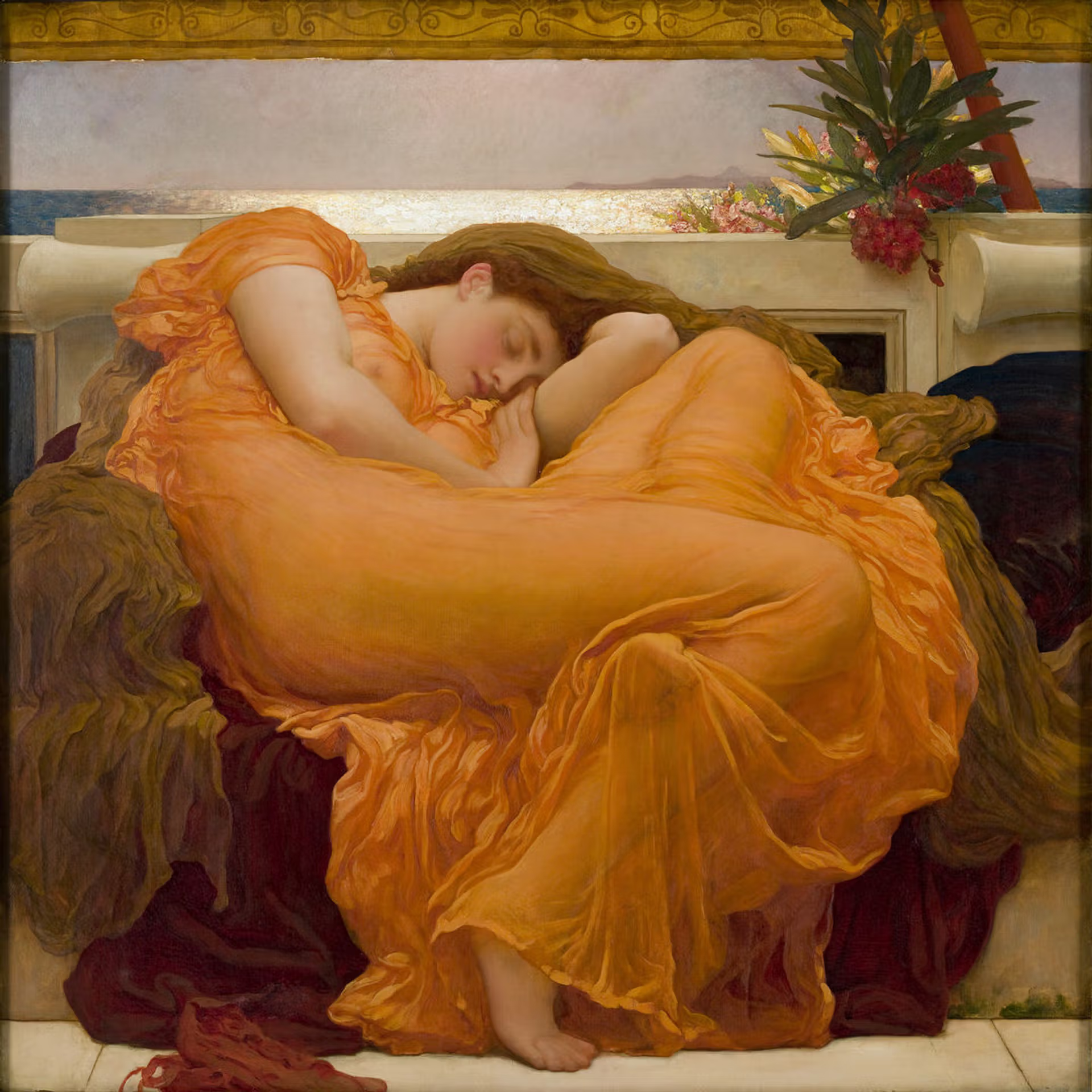

Frederic Leighton’s Flaming June (c.1895), held by the Ponce Art Museum in Puerto Rico, is a luminous example of late Neoclassicism. The oil on canvas, measuring 120 by 120 centimeters, depicts a sleeping woman in a translucent orange gown, her body curled into a sun-like orb on a marble bench. Set against a sliver of sea and sky, the scene radiates warmth through its rich reds and golds. Symbolizing both repose and mortality, the composition balances classical idealism with emotional depth, affirming Leighton’s mastery of the academic tradition while suggesting the transience of beauty and life.
Ratings / Reviews
Información adicional
| Dimensions | Original: 120 cm x 120 cm, Small: 48 cm x 48 cm, Medium: 72 cm x 72 cm, Large: 96 cm x 96 cm |
|---|
$396.00 – $1,152.00Price range: $396.00 through $1,152.00
Completed in the closing years of Frederic Leighton’s life, Flaming June (c.1895) is a culminating expression of his Neoclassical ideals rendered with sensuous intensity. Painted in oil on canvas and measuring 120 by 120 centimeters, the work now resides in the Ponce Art Museum in Puerto Rico. It exemplifies the late Victorian academic style, marked by refined technique, allegorical subject matter, and an emphasis on idealized form. Within this framework, Leighton infuses the painting with a luminous vibrancy that aligns with both the rigor of Neoclassicism and the emotional nuance of fin-de-siècle aestheticism.
The composition presents a young woman sleeping, her body curled into a circular pose upon a marble bench. Draped in a translucent orange gown, she is enveloped by folds of red and golden fabric that amplify the chromatic intensity. This radiant palette appears to set the figure aflame, echoing the sun whose light is only implied through the narrow, almost-white strip of sea and sky behind her. The Mediterranean atmosphere—suggested by the architecture and distant coastline—may allude to Leighton’s travels in southern Europe and the classical world, both formative influences on his artistic vision.
The painting’s formal structure is compact and harmonious. The woman’s limbs, compressed into a near-orb, evoke the sun as much as they suggest repose. Her foot, barely resting on its toe, reveals a tension beneath the surface calm. This interplay of stillness and latent energy typifies Leighton’s figural work, where beauty is never static but charged with subtle dynamism. The ornamental frieze above the sea reduces spatial depth, creating a confined, almost dreamlike atmosphere.
Beneath its aesthetic allure, Flaming June carries symbolic weight. The woman’s sleep has been widely interpreted as a metaphor for death, a theme underscored by the oleander in the upper right corner—a flower associated with poison. This layer of memento mori deepens the painting’s emotional register and reflects the melancholic undertones found in Leighton’s late work.
With its idealized female form, radiant palette, and allegorical dimension, Flaming June stands as a quintessential Neoclassical painting. It embodies the intellectual discipline and compositional clarity of the movement, while also embracing the emotive richness and visual splendor that defined British academic art at the turn of the century.