
Mona Lisa (La Gioconda)

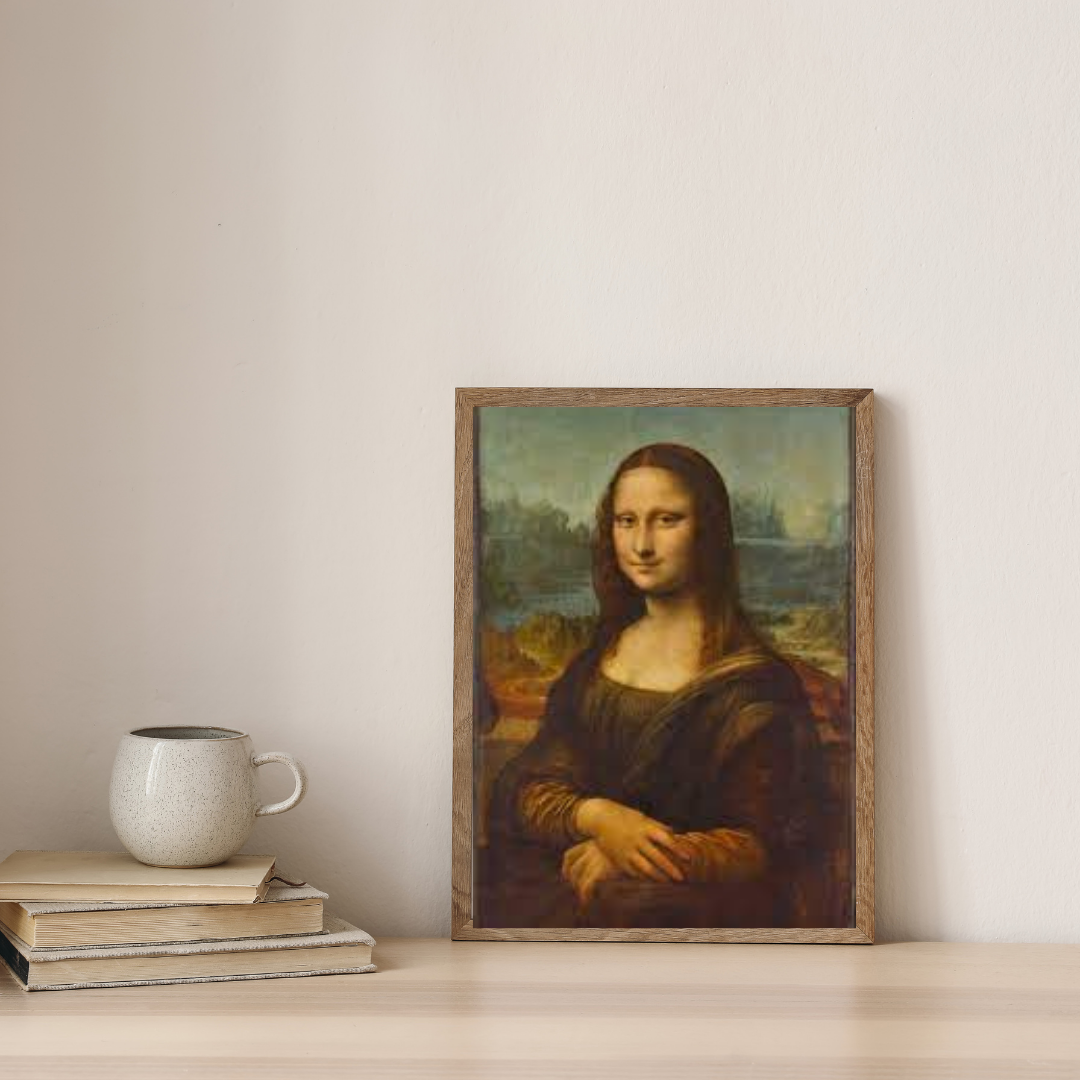
Painted circa 1503–1506 and measuring 77 × 53 cm, this Renaissance masterpiece captures the enigmatic expression of Lisa Gherardini, known as La Gioconda. Leonardo’s use of sfumato and atmospheric background gives the portrait its dreamlike quality. The most famous painting in history, Mona Lisa is housed at the Louvre Museum in Paris.
Ratings / Reviews
Información adicional
| Dimensions | Original: 77 cm x 53 cm, Small: 61.6 cm × 42.4 cm, Medium: 92.4 cm × 63.6 cm, Large: 107.8 cm × 74.2 cm |
|---|
$356.00 – $640.00Price range: $356.00 through $640.00
Mona Lisa, also known as La Gioconda, is one of the most iconic and enigmatic portraits in the history of art. Painted by Leonardo da Vinci between 1503 and 1506 during the Renaissance, the portrait is widely believed to represent Lisa Gherardini, the wife of Florentine merchant Francesco del Giocondo. Measuring 77 × 53 cm, this half-length composition presents the sitter seated in a calm, composed posture—one arm resting on a chair, the other gently draped across her wrist.
Leonardo’s masterful use of sfumato, a technique that creates soft transitions between tones and colors, envelops Mona Lisa in a tranquil atmosphere that extends into the hazy, imaginary landscape behind her. The subtle blending of light and shadow, especially around the corners of her mouth and eyes, is key to the painting’s most celebrated feature: her enigmatic smile. As art historian Ernst Gombrich once observed, Leonardo left these key facial features deliberately indistinct, creating an expression that seems to change depending on the viewer’s focus and perspective—at once serene, amused, and mysterious.
Unlike most portraits of the era, which focused on the sitter’s external appearance and often used symbolic elements to hint at personality, Leonardo sought to reveal something deeper. With Mona Lisa, he aimed to capture the soul of the subject, portraying a sense of inner life through the slight tilt of her head and the elusive quality of her smile.
The background, often speculated upon, is generally accepted to be imaginary, conjured from Leonardo’s imagination and perhaps meant to reflect the dreamlike interior world of the sitter herself. This imaginative quality enhances the psychological depth of the work, making the viewer feel as though they are peering into a moment of quiet introspection.
Over the centuries, the Mona Lisa has become the most famous painting in the world, influencing generations of artists and capturing the public’s imagination. Raphael made a drawing inspired by the portrait as early as 1504. In literature, the painting has been celebrated by writers such as Théophile Gautier, who called her “the sphinx who smiles so mysteriously.” Her image has also been adapted and parodied throughout modern culture—Eugène Bataille imagined her smoking a pipe in 1883, Marcel Duchamp gave her a mustache in 1919, and Andy Warhol reproduced her in his 1963 silkscreen Thirty Are Better Than One. Salvador Dalí even painted his Self-Portrait as Mona Lisa in 1954.
From high art to pop culture, postcards to posters, the Mona Lisa’s image is recognized across the globe. Yet, despite the fame, the painting retains its mystery. The blend of technical mastery, subtle emotion, and psychological complexity has allowed Leonardo’s masterpiece to transcend time and medium.
Today, Mona Lisa hangs behind bulletproof glass at the Louvre Museum in Paris, where millions of visitors come each year to encounter her legendary gaze—and leave pondering what lies behind that eternal smile.