
Salvatore Mundi
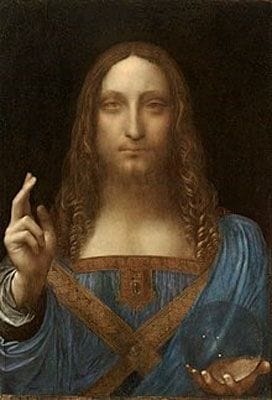
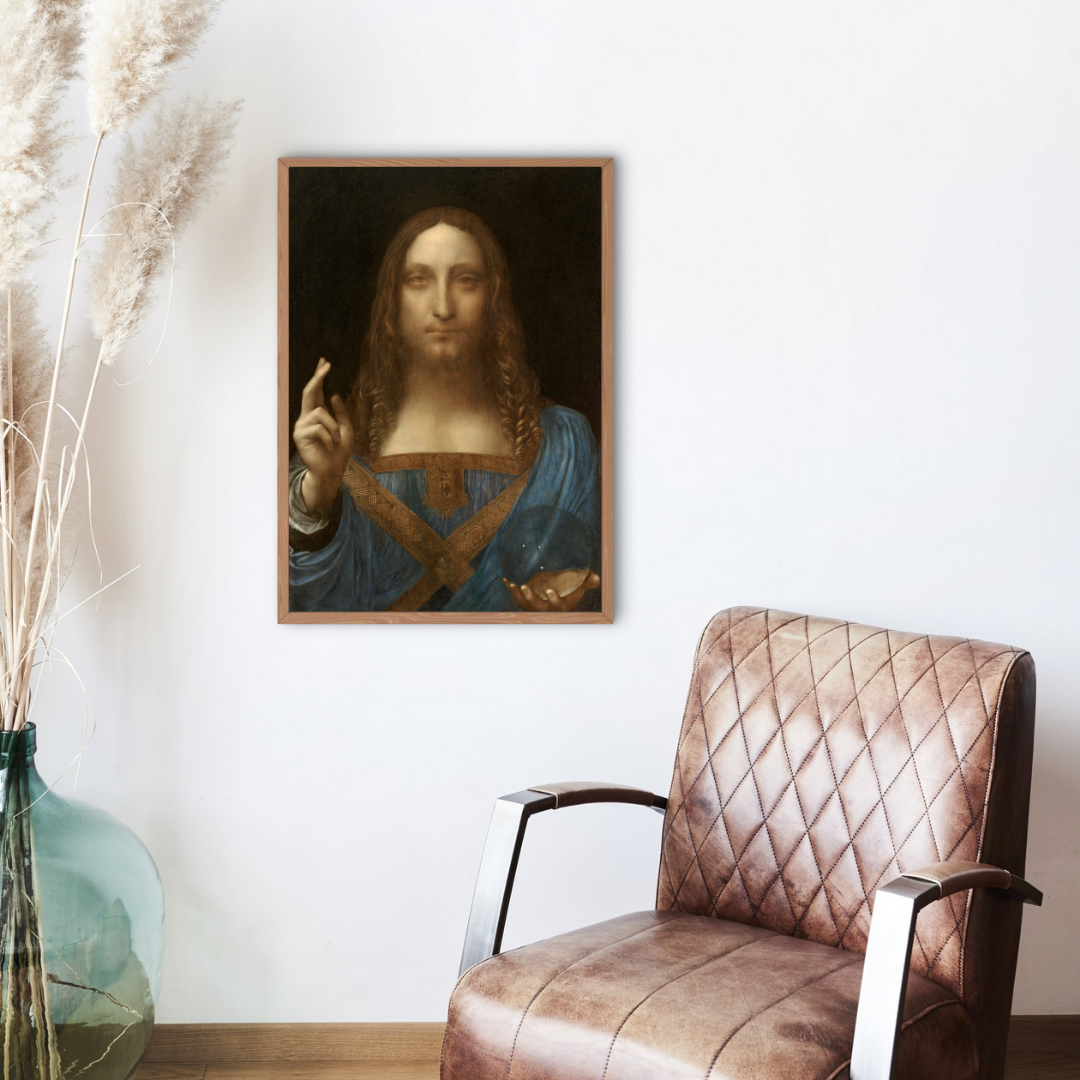
Measuring 66 × 45 cm, this Renaissance oil-on-wood panel depicts Christ as the savior of the world, offering a divine blessing while holding a crystalline orb. Painted in a rare half-length format, it features Leonardo’s masterful sfumato technique and intimate humanism. After extensive restoration and a landmark 2017 auction sale for $450 million, it is now held in a private collection.
Ratings / Reviews
Información adicional
| Dimensions | Original: 66 cm x 45 cm, Small: 52.8 cm × 36 cm, Medium: 79.2 cm × 54 cm, Large: 92.4 cm × 63 cm |
|---|
$356.00 – $615.00Price range: $356.00 through $615.00
Salvator Mundi is a powerful and enigmatic painting, attributed to Leonardo da Vinci, depicting Jesus Christ as the savior of the world and master of the cosmos. Said to have been commissioned by King Louis XII of France after his conquest of Milan in 1499, the painting presents Christ in a deeply symbolic and humanist form. With his right hand raised in a gesture of divine benediction and his left holding a crystalline sphere representing the heavens, the portrait merges spiritual iconography with Renaissance innovation.
Measuring 66 x 45 cm, this oil-on-wood panel is a remarkable example of the Renaissance movement’s ideals—merging realism, religious symbolism, and anatomical precision. What sets this painting apart is its intimate and radical presentation of Christ. Rather than a distant, idealized figure, Jesus appears in contemporary Renaissance attire, gazing directly at the viewer. This half-length composition, uncommon at the time, enhances the sense of closeness and emotional connection.
Leonardo’s signature sfumato technique gives the figure a soft, almost otherworldly presence. The subtle shadows and refined expression lend Christ a calm spiritual authority, while light seems to emanate from his chest, reinforcing his role as a bringer of divine illumination. Despite its spiritual subject, the work reflects Renaissance humanism through its focus on anatomy, emotion, and realism. Jesus’s features are rendered with remarkable precision, and the dark background from which he emerges creates a striking contrast with the soft glow of his skin and garments.
The painting’s history is as compelling as the image itself. After disappearing from record between 1763 and 1900, it resurfaced misattributed as a work by Bernardino Luini. It sold at Sotheby’s in London in 1958 for just £45 ($125). Severely damaged, it changed hands again in 2005 when it was acquired by an independent U.S. auction house. Following extensive restoration and renewed scholarly attention, it was reattributed to Leonardo in the early 2000s—though some experts continue to question this attribution.
In 2017, Salvator Mundi made headlines worldwide when it was auctioned at Christie’s New York for $450 million, setting a new record for the most expensive painting ever sold. Today, it remains in a private collection.
Salvator Mundi stands as a rare convergence of religious symbolism, artistic mastery, and historical intrigue—an enduring testament to Leonardo da Vinci’s genius and the profound power of visual storytelling.