
The Avenue in the Rain
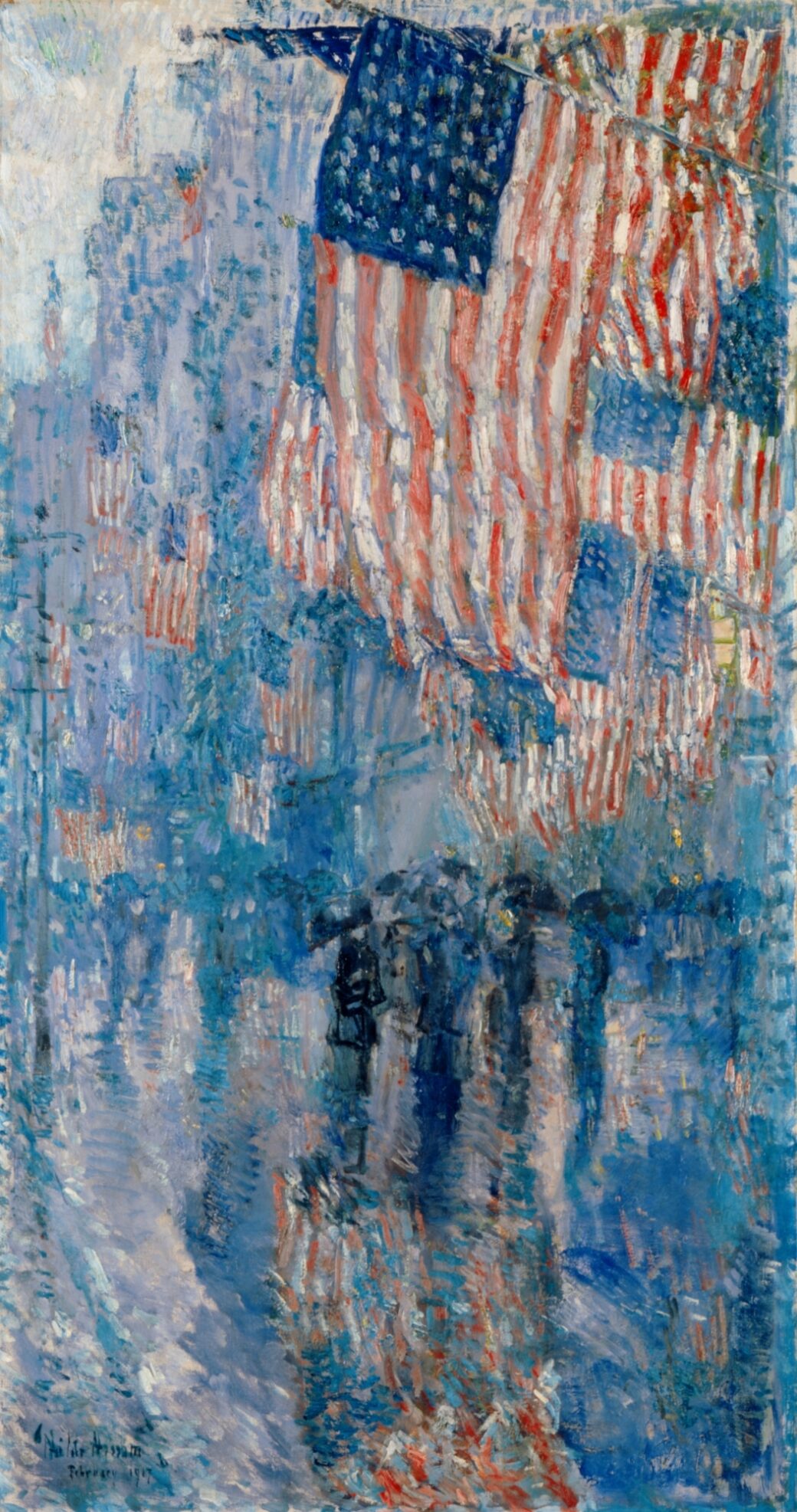

Avenue in the Rain (106.7 cm × 56.5 cm), painted by Childe Hassam in 1917, is an iconic work of American Impressionism. Part of a series of paintings featuring flags on New York’s Fifth Avenue during World War I, the piece captures the intense patriotic fervor of the time. With its dramatic projection of flags, the painting transforms into a vibrant symbol of the American flag itself. The painting is currently housed in the White House, Washington D.C.
Ratings / Reviews
Información adicional
| Dimensions | Original: 106.7 cm × 56.5 cm, Small: 85.4 cm × 45.2 cm, Medium: 128.0 cm × 67.8 cm, Large: 149.4 cm × 79.1 cm |
|---|
$276.00 – $477.00Price range: $276.00 through $477.00
Childe Hassam, a prominent figure in American Impressionism, was the leading artist of the “Ten American Painters,” a group founded in 1898. Known for his rich, vibrant landscapes and urban scenes, Hassam was deeply influenced by French Impressionism. His time spent studying in France in the late 1880s exposed him to the techniques of the French Impressionists, which he emulated with his signature broken brushwork and intense color palette. Though regarded as the foremost American Impressionist, Hassam was somewhat conservative stylistically, preferring elegant depictions of figures and clothing. His works capture moments of both vibrancy and tranquility, reflecting his love of the urban landscape and his active participation in the cultural life of his time.
One of Hassam’s most iconic works, Avenue in the Rain, was painted in February 1917, during the height of his career. It is part of a series of 30 paintings depicting streets adorned with flags that he produced between 1916 and 1919, during and immediately after World War I. The series is deeply infused with the artist’s intense patriotism, and Avenue in the Raincaptures the fervor of the time. The scene is set on Fifth Avenue in New York City, often draped with flags as a symbol of national pride as the country’s sentiment shifted from isolationism to involvement in the war.
Hassam’s painting reflects the influence of Claude Monet’s flag paintings, particularly those created in 1878, and the technique of painting the same motif multiple times. The visual impact of the flags, dramatically projected onto the canvas from points beyond the frame, nearly dominates the composition, creating a striking dynamic. This approach transformed the flags into the very surface of the painting, an identity reinforced by the vertical format, which evokes the shape of a flag itself.
In a historical context, Avenue in the Rain was painted just after President Wilson’s “Peace Without Victory” speech in January 1917, advocating for a peace settlement in World War I. Yet, by this time, American entry into the war was inevitable, given the mounting tensions with Germany. The German announcement of unrestricted submarine warfare and the infamous Zimmermann Telegram—the intercepted German diplomatic note offering a military alliance to Mexico against the U.S.—signaled a turning point. The wave of patriotism and nationalism reached its zenith, and Hassam’s flag paintings like Avenue in the Rain serve as both artistic and symbolic representations of this fervor. The work is, in essence, not just a street scene or a depiction of flags, but a painting that itself becomes a vibrant symbol of the American flag.
The painting now resides in the White House, further cementing its importance as a symbol of American pride and history.