
The Tree of Life
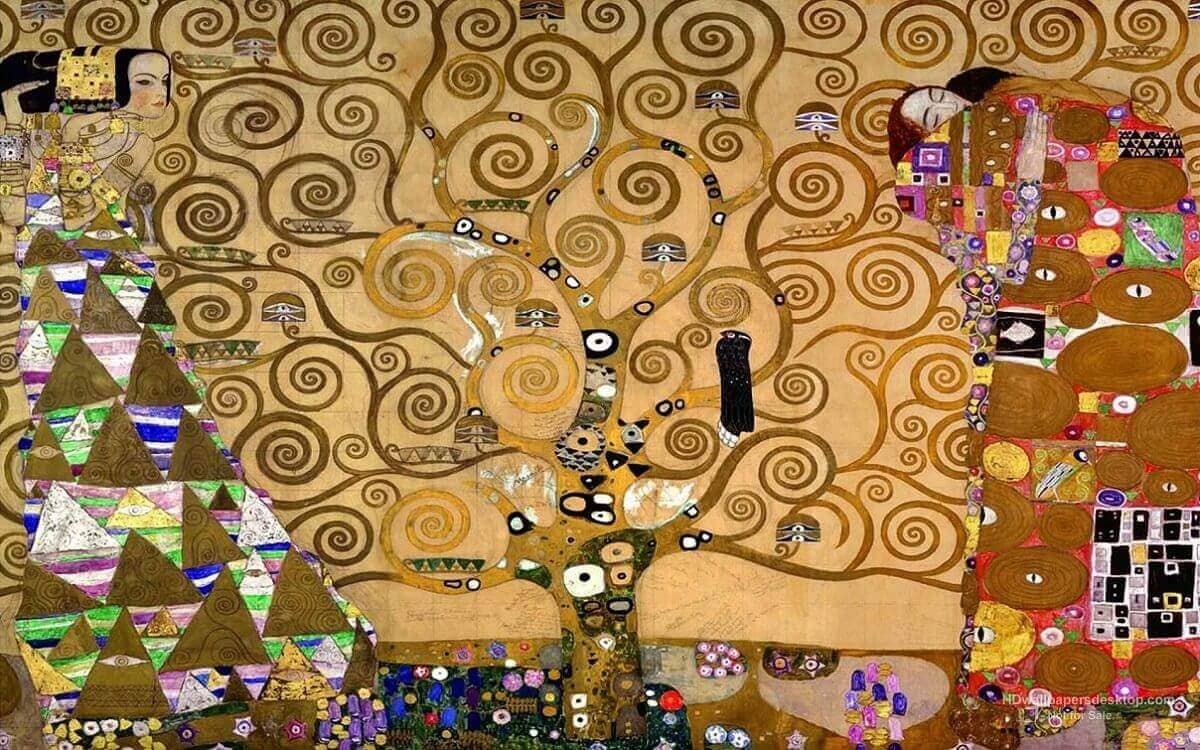
Gustav Klimt’s The Tree of Life, Stoclet Frieze (1905–1909) is a dazzling Symbolist mural composed with oil and gold leaf on plaster. A masterpiece of his Golden Period, it explores life’s eternal cycle through swirling branches, divine connections, and a single black bird symbolizing death. Housed in the Museum of Applied Arts (MAK) in Vienna, it is one of Klimt’s most iconic and spiritually resonant works.
Ratings / Reviews
Información adicional
| Dimensions | Original: 200 cm x 102 cm, Small: 80 cm × 40.8 cm, Medium: 120 cm × 61.2 cm, Large: 160 cm × 81.6 cm |
|---|
$316.00 – $1,084.00Price range: $316.00 through $1,084.00
Gustav Klimt’s The Tree of Life, Stoclet Frieze is one of the most emblematic works from the artist’s famed Golden Period and stands as a dazzling intersection of art, myth, and spirituality. Created between 1905 and 1909 as part of a decorative mosaic frieze for the Stoclet Palace in Brussels—a masterpiece of early modern architecture—this mural occupies a central place in both Klimt’s career and in the world of Symbolist art.
The Tree of Life is a motif present in numerous mythologies, theologies, and philosophies around the world. It represents the axis mundi, the central connection between heaven, earth, and the underworld. Klimt’s visual interpretation of this concept is bold, rich, and uniquely stylized. The swirling, intricate branches of the tree—rendered in ornate gold leaf and delicate line—evoke a sense of eternal movement and complexity. These whorls and spirals are not only decorative but deeply symbolic, alluding to life’s infinite cycle and the entanglement of fate, growth, and decay.
With its branches stretching toward the heavens and roots anchored to the earth, Klimt’s tree represents the vertical journey of existence—from divine aspirations to human groundedness and eventual return to the soil. At the same time, the horizontal spread of the mural contains two human figures (in the complete frieze): a standing female figure in a richly patterned gown (believed to represent Expectation), and a loving couple in an embrace (symbolizing Fulfillment). Together, they reinforce the themes of life, love, union, and transcendence.
Klimt also included a single black bird—often interpreted as a raven—a reminder of death’s inevitability and a grounding contrast to the overwhelming brilliance of the gold leaf. The presence of this bird subtly introduces mortality and the passage of time, drawing the viewer’s eye to the core of the composition and inviting contemplation. Despite the gold’s opulence and the mythic resonance of the tree, the bird reminds us that all beginnings have endings.
Symbolist in movement but highly influenced by Art Nouveau, Klimt’s mural combines masculine and feminine elements, thought by some to reflect the duality and balance of creation: the nurturing, flowing curves of the feminine alongside the strong verticals and phallic motifs of the masculine. Others read the work as a symbolic unification of humanity’s greatest virtues—strength, wisdom, and beauty—interwoven through the tree’s eternal limbs.
The Tree of Life, Stoclet Frieze is not just a visual feast of ornament and symbolism; it is also an invitation to linger, reflect, and meditate on the mysteries of existence, connection, and eternity.