
View of Delft

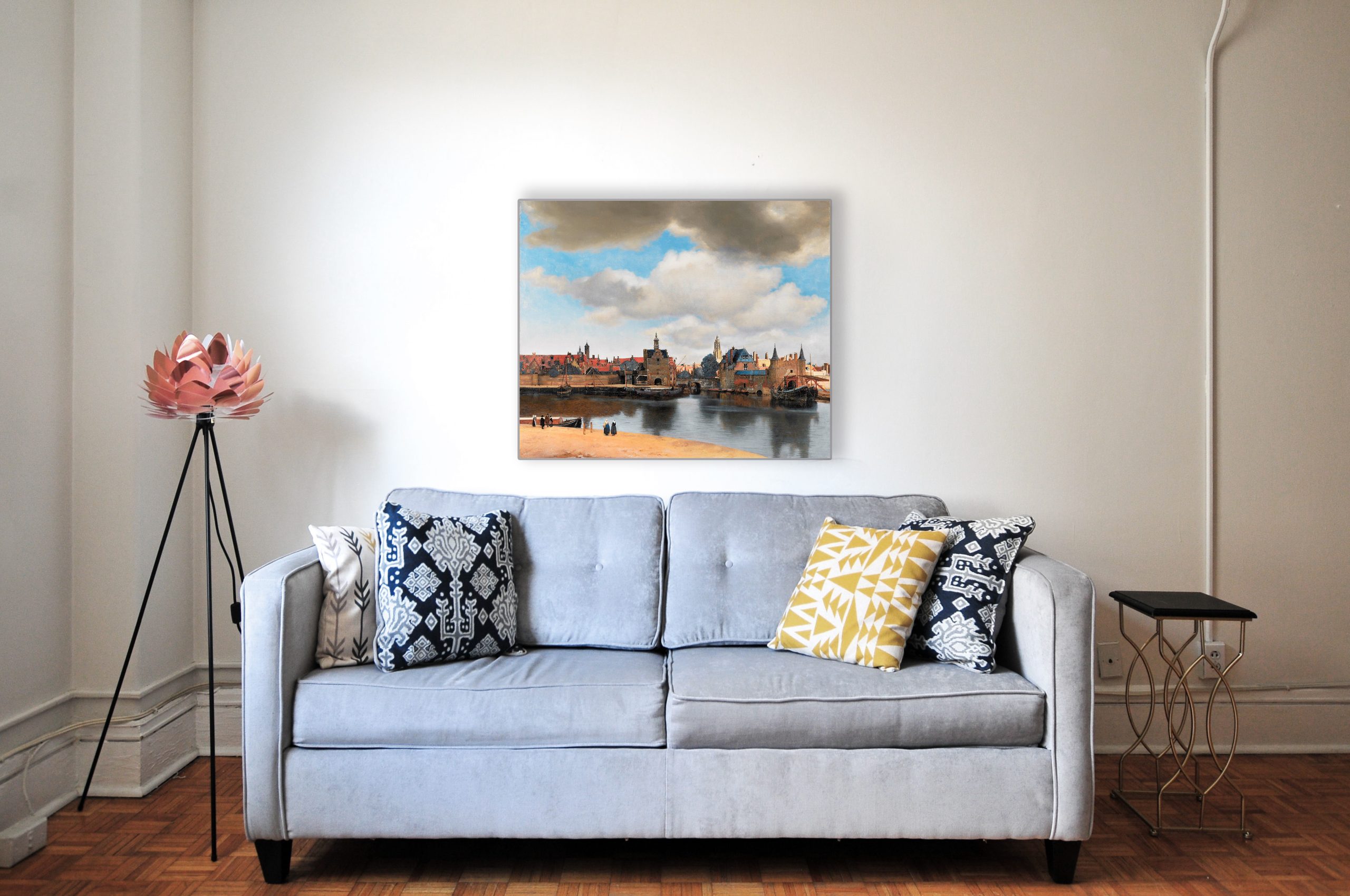
Johannes Vermeer’s View of Delft (1660–1661), measuring 96.5 cm × 115.7 cm and housed at the Mauritshuis, The Hague, is the most celebrated cityscape of the Dutch Golden Age. Painted in the Baroque style, it shows Delft from the southeast, with the Kolk harbor in the foreground and the New Church tower rising above the city. Vermeer balanced realism with subtle adjustments to create a calm, horizontal composition bathed in alternating light and shadow. Renowned for its harmony and detail, the work became famous in the nineteenth century and remains an enduring masterpiece of urban landscape painting.
Ratings / Reviews
Información adicional
| Dimensions | Original: 96.5 cm x 115.7 cm, Small: 38.6 cm x 46.3 cm, Medium: 57.9 cm x 69.4 cm, Large: 77.2 cm x 92.6 cm |
|---|
$396.00 – $892.00Price range: $396.00 through $892.00
Johannes Vermeer’s View of Delft (1660–1661) is widely regarded as the most celebrated cityscape of the Dutch Golden Age and one of the most iconic works in seventeenth-century Baroque painting. Measuring 96.5 cm × 115.7 cm and housed in the Mauritshuis, The Hague, the work captures the city from the southeast, looking across the Kolk harbor under a luminous sky.
The scene shows a tranquil Delft bathed in alternating sunlight and shadow. The Schiedam and Rotterdam gates mark the skyline, with the tower of the New Church rising prominently above the clustered rooftops. Though the composition is dominated by architecture and atmosphere, human activity plays a minor role: a few figures stroll along the quay, their presence subtle yet vital in animating the stillness. The boats lie at rest, sails lowered, while the calm water reflects the buildings and sky in softly rippling patches. The time appears to be a clear morning in late spring or summer, with the eastern light illuminating the façades.
One of Vermeer’s most striking achievements in View of Delft lies in the balance of realism and compositional refinement. While topographical drawings from the same vantage point show a less orderly skyline, Vermeer subtly reorganized elements of the scene. The bridge between the city gates is lengthened and straightened, certain structures are lowered, and potential glimpses of distance are blocked by trees. These adjustments heighten the painting’s sense of calm horizontality—water, architecture, and sky layered harmoniously.
Vermeer’s technical precision is equally remarkable. The sunlit yellow roof at the right is rendered with textured pigment to suggest the uneven surface of its tiles. The tower of the New Church glows under smooth applications of lead-tin yellow, shimmering in the strong light. Tiny, precise dots along a moored boat near the Rotterdam Gate mimic the sparkle of water on its hull—an early example of Vermeer’s innovative optical effects.
Though little recognized in his own century, Vermeer’s reputation grew steadily after the writings of art critic Étienne-Joseph Thoré in the mid-nineteenth century. View of Delft became especially celebrated in the twentieth century, in part through the admiration of novelist Marcel Proust, who immortalized the painting in À la recherche du temps perdu. Today, it remains one of the finest examples of Vermeer’s artistry—an enduring harmony of light, structure, and serenity.