
Lady with Fan
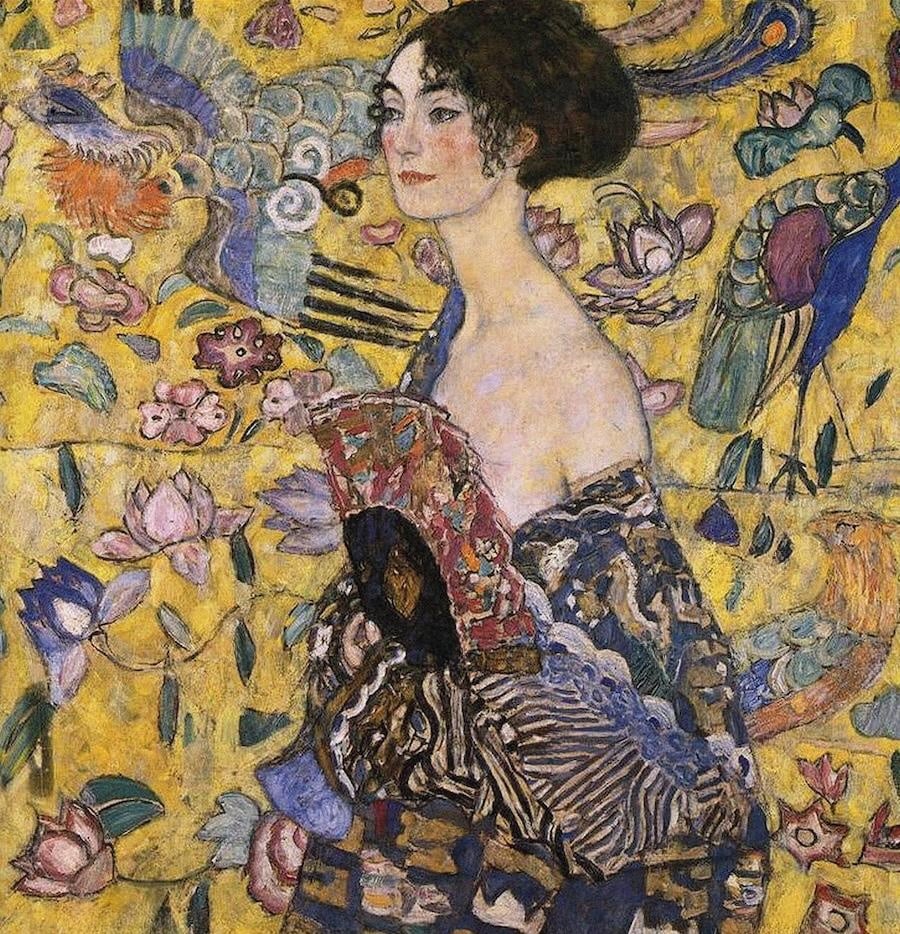

Gustav Klimt’s Lady with Fan (1918), oil on canvas, 100 cm × 100 cm, now in a private collection, is the artist’s final completed work. Depicting an unidentified woman—possibly a dancer—against a vibrant yellow background filled with stylized birds and flowers, the composition reflects Klimt’s enduring fascination with the female form and his engagement with Japonism. The intricate patterns of the sitter’s dress and fan, together with the luminous color palette, recall both Rococo elegance and Klimt’s golden period. Completed in the final year of his life, the painting merges sensuality, ornament, and symbolic refinement, serving as a luminous conclusion to his career and a testament to the Viennese Secession ideals.
Ratings / Reviews
Additional information
| Dimensions | Original: 100 cm × 100 cm, Small: 40 cm x 40 cm, Medium: 60 cm x 60 cm, Large: 80 cm x 80 cm |
|---|
$396.00 – $880.00Price range: $396.00 through $880.00
Gustav Klimt’s Lady with Fan (1918) is among the artist’s final works, completed in the year of his death. Measuring 100 × 100 cm and painted in oil on canvas, it captures his enduring fascination with the female form while incorporating stylistic influences from Japonism and Rococo ornamentation. The sitter remains unidentified, though exhibition records list an alternative title, Bailarina (Tänzerin), suggesting she may have been a dancer—reflecting Klimt’s preference for sitters comfortable with performance and poised self-presentation.
The composition presents the figure before a luminous yellow background animated by stylized birds, flowering vines, and decorative motifs. These elements recall Japanese woodblock prints, evidence of Klimt’s sustained engagement with Far Eastern aesthetics, a prominent interest within the Viennese Secession. The dominance of yellow also echoes his celebrated “golden period” works, in which color and ornament conveyed a sense of luxury and refinement.
The sitter’s patterned dress and the fan she holds are richly decorated, reflecting the Arts and Crafts movement’s emphasis on intricate design. In Lady with Fan, Klimt integrates ornament directly into the structure of the painting, erasing boundaries between fine and decorative art. This synthesis reflects the Secessionist ideal—championed by Klimt since 1897—of uniting all art forms in a harmonious whole.
The figure is turned slightly in profile, her bare shoulder exposed, gaze directed beyond the canvas. This combination of natural sensuality and composed elegance reveals Klimt’s hallmark balance of eroticism and restraint. Far from overpowering the subject, the ornamental background enhances her presence, merging the sitter’s vitality with the opulent environment.
Completed in the final months of Klimt’s life, Lady with Fan serves as a summation of his mature style. It retains the decorative brilliance of his earlier years while demonstrating a looser, more confident handling of form and surface. In its interplay of sensuality, stylized design, and vibrant color, the painting stands as both a culmination of his artistic evolution and a fitting close to his career. Today, Lady with Fan remains one of Klimt’s most celebrated late works, embodying the Viennese Secession’s ideals and the enduring appeal of his vision of beauty.