
The Siesta

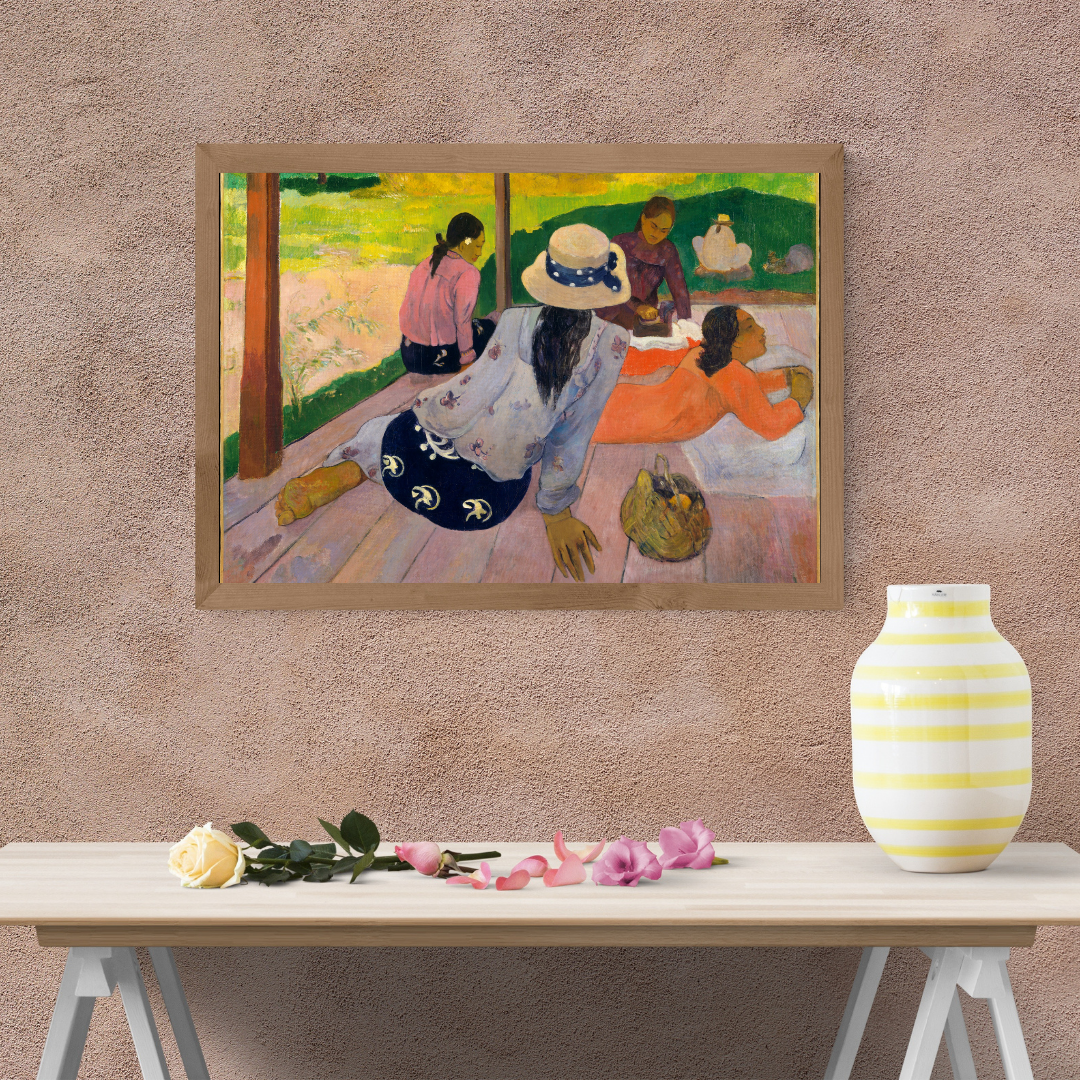
Paul Gauguin’s The Siesta (ca. 1892–1894), oil on canvas (88.9 × 116.2 cm, Metropolitan Museum of Art), captures Tahitian women resting on a shaded veranda during midday. Depicting a tranquil domestic moment, the painting reflects Gauguin’s Post-Impressionist style, with strong outlines, warm colors, and simplified forms. Originally reworked multiple times, its final composition balances harmony and stillness. The work embodies Gauguin’s fascination with Tahitian life, presenting an idealized vision of its grace and tranquility. Both intimate and stylized, The Siesta blends cultural observation with the artist’s personal search for beauty and simplicity beyond the confines of European society.
Ratings / Reviews
Additional information
| Dimensions | Original: 88.9 cm x 116.2 cm, Small: 71.1 cm x 93 cm, Medium: 106.7 cm x 139.4 cm, Large: 124.5 cm x 162.7 cm |
|---|
$356.00 – $1,076.00Price range: $356.00 through $1,076.00
Paul Gauguin’s The Siesta (ca. 1892–1894), an oil on canvas measuring 88.9 × 116.2 cm, offers an intimate view of Tahitian domestic life. Painted during Gauguin’s time in French Polynesia, the work captures a quiet midday moment on a shaded veranda, where several Tahitian women rest during the heat of the day. Now housed in the Metropolitan Museum of Art, the painting reflects both Gauguin’s deep engagement with local life and his departure from European artistic conventions.
The composition presents a group of women arranged in a relaxed scene: one reclines, another sits quietly, and a third tends to ironing. Their unaffected ease conveys a communal rhythm of daily life far removed from the industrial pace of Europe. Behind them, lush greenery hints at the tropical setting, while the wooden veranda provides a sense of enclosure and domesticity.
Gauguin reworked the composition over time, making numerous adjustments that speak to his meticulous creative process. The skirt of the woman in the foreground was originally painted bright red, a dog once occupied the space where a basket now rests, and the seated figure on the left was repositioned for greater compositional balance. These changes contribute to the harmonious stillness that defines the scene.
Stylistically, The Siesta exemplifies Gauguin’s Post-Impressionist approach. Strong outlines, bold areas of color, and simplified forms replace Impressionism’s fleeting brushwork. His warm palette of ochres, greens, and muted reds evokes the island’s tropical light and climate, while the deliberate flattening of space reflects his interest in symbolic form over strict naturalism.
Thematically, the painting is both a document of daily life and an idealized vision of Tahitian tranquility. It reflects Gauguin’s fascination with what he perceived as the purity and grace of indigenous culture, as well as his search for an escape from the constraints of European society. At the same time, The Siesta reveals the complexity of cross-cultural encounter, with Gauguin’s perspective shaped by his position as both observer and outsider.
Through its quiet mood, compositional refinement, and richly colored surfaces, The Siesta stands as a testament to Gauguin’s vision of Tahiti—a world at once real and imagined, grounded in daily life yet transformed through the lens of his artistic ideals.