
Innocence
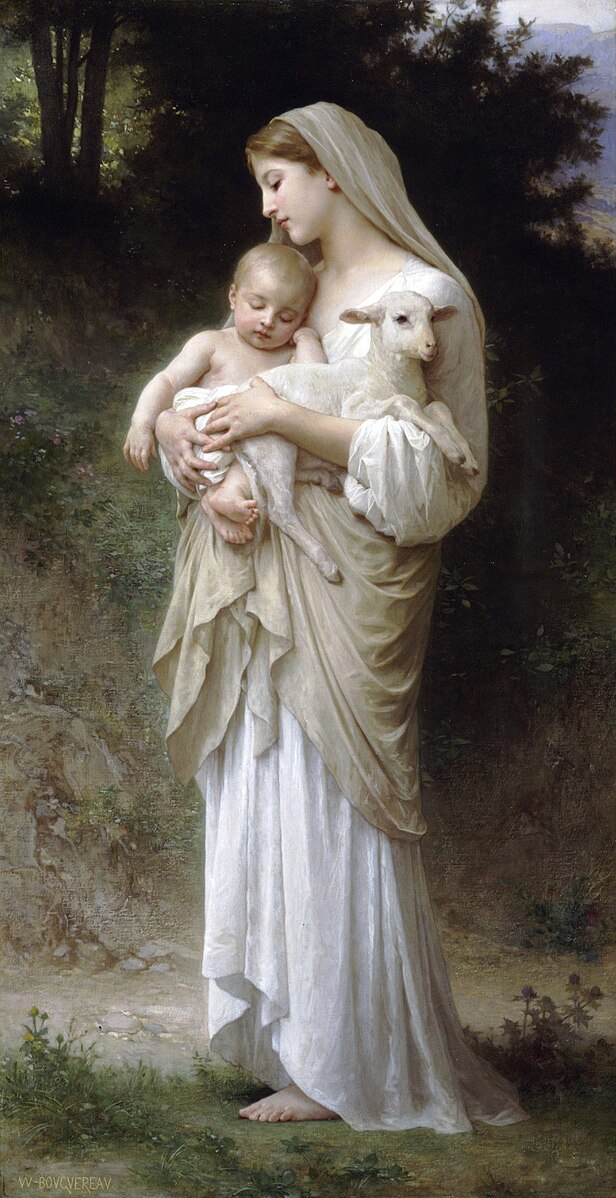

William-Adolphe Bouguereau’s Innocence (1893), housed in the Audrey Jones Beck Building in Houston, is a refined academic painting that captures the symbolic beauty of purity and youth. Measuring 100 by 52.5 centimeters, the composition features a young child tenderly holding a lamb—traditional emblems of innocence in Western art. Bouguereau’s hallmark realism is evident in the soft rendering of skin, delicate folds of fabric, and lifelike textures. With its quiet spiritual overtones and classical restraint, Innocence exemplifies Bouguereau’s commitment to idealized beauty, while its wide digital circulation ensures the continued relevance of his academic legacy.
Ratings / Reviews
Additional information
| Dimensions | Original: 100 cm x 52.5 cm, Small: 40 cm x 21 cm, Medium: 60 cm x 31.5 cm, Large: 80 cm x 42 cm |
|---|
$396.00 – $684.00Price range: $396.00 through $684.00
Painted in 1893, Innocence by William-Adolphe Bouguereau is a masterful expression of academic art, merging technical precision with symbolic depth. Measuring 100 by 52.5 centimeters, the oil on canvas work resides in the Audrey Jones Beck Building, part of the Museum of Fine Arts in Houston. It exemplifies Bouguereau’s unmatched ability to portray the human form with anatomical accuracy and emotional nuance, while also conveying the classical virtues of purity, virtue, and grace that defined much of his artistic philosophy.
The painting features a young child holding a lamb in a quiet, intimate pose. This serene composition draws upon long-standing Christian iconography in which both children and lambs are emblematic of innocence and purity. The lamb, often associated with Christ as the sacrificial “Lamb of God,” deepens the spiritual resonance of the image. The child’s gaze, downcast and tranquil, reinforces the theme of spiritual contemplation and gentleness. These elements work in harmony to elevate the painting beyond simple portraiture, transforming it into an allegory of moral and spiritual ideals.
Bouguereau’s approach to realism is marked by a meticulous treatment of surfaces and textures. The child’s skin is rendered with a softness that suggests fragility and tenderness, while the lamb’s fleece is depicted with tactile precision. The drapery of the clothing is composed with flowing, almost sculptural folds, further demonstrating Bouguereau’s control over form and light. The overall effect is one of idealized naturalism—a hallmark of his academic style, which sought to reconcile emotional depth with classical restraint.
Though Bouguereau was often critiqued by modernist contemporaries for his adherence to traditional methods, works such as Innocence affirm his lasting impact. The painting stands as a quiet meditation on childhood and purity, themes that transcend specific religious or cultural contexts. It aligns with the broader goals of 19th-century Academicism, where beauty and moral clarity were paramount.
Today, Innocence continues to resonate through its widespread digital accessibility, particularly in public domain archives and encyclopedic platforms. As an image circulated far beyond the museum walls, it remains a widely recognized representation of idealized innocence. Bouguereau’s legacy, grounded in technical mastery and timeless symbolism, is preserved not only in museums but also through his enduring digital presence.