
Impression, Sunrise (Impression, Soleil Levant)
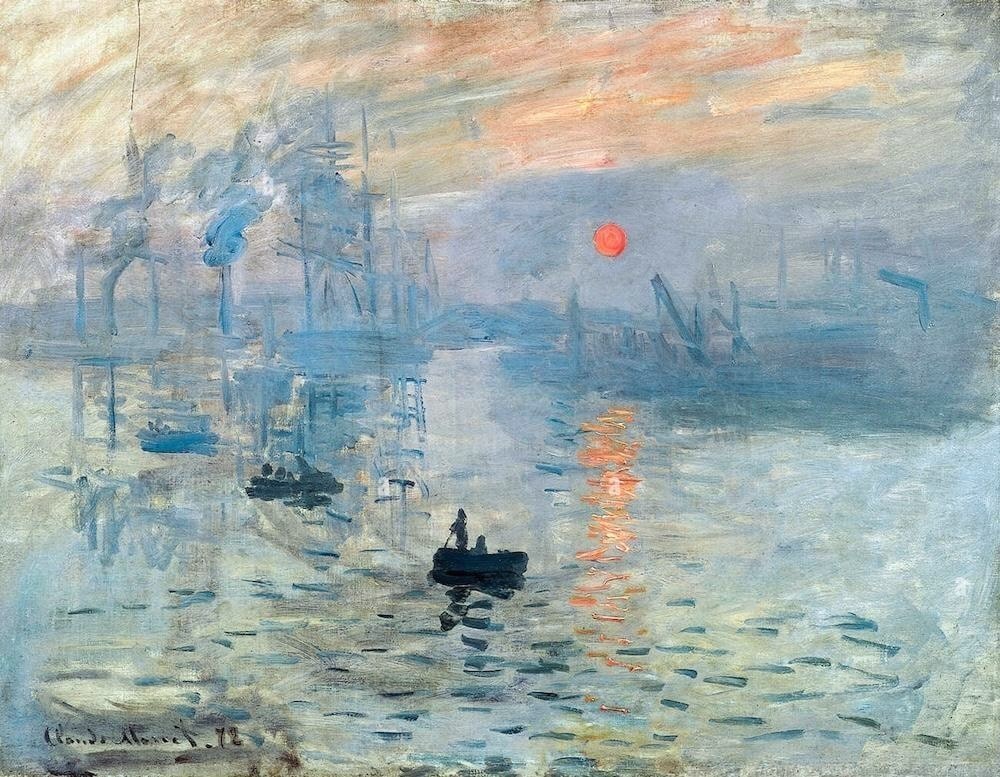

Measuring 48 × 63 cm, this 1872 painting of Le Havre’s harbor is a landmark of Impressionism and the work that gave the movement its name. With hazy light, muted tones, and sketch-like brushwork, Monet captures a fleeting moment of atmosphere and movement. Originally ridiculed, it now stands as one of the most iconic works of modern art. On view at the Musée Marmottan Monet.
Ratings / Reviews
Información adicional
| Dimensions | Original: 48 cm x 63 cm, Small: 38.4 cm × 50.4 cm, Medium: 57.6 cm × 75.6 cm, Large: 67.2 cm × 88.2 cm |
|---|
$236.00 – $408.00Price range: $236.00 through $408.00
Impression, Sunrise is one of the most iconic works by Claude Monet and the painting that gave the Impressionist movement its name. Created from a scene in the port of Le Havre, the work captures the misty morning light over the French harbor in a way that feels immediate, fleeting, and profoundly atmospheric. Measuring 48 × 63 cm, this 1872 painting belongs to the Impressionism movement and is now housed at the Musée Marmottan Monet.
Monet depicts a haze-laden harbor where the orange and yellow hues of the rising sun contrast vividly with the dark silhouettes of boats and industrial structures. Little detail is visible—intentionally so. The artist focuses instead on mood, motion, and light, stripping away realism to evoke a moment’s impression. Smaller boats in the foreground seem to glide across the water, propelled by its gentle movement. This sensation is enhanced by loose, spontaneous brushstrokes that scatter color across the surface, making the sea shimmer and sparkle.
While Impression, Sunrise has become emblematic of Monet’s work and of Impressionism as a whole, it is, in some ways, uncharacteristic of both. The colors are muted, the paint applied in thin washes rather than bold, broken brushwork, and the use of impasto is limited only to the reflected sunlight on the water. In certain areas, the canvas even shows through. Monet himself considered the piece unfinished, which is why he titled it Impression—to distinguish it from more “complete” works, such as another view of Le Havre he exhibited at the same time.
The painting was first shown between April 15 and May 15, 1874, in the first group exhibition organized by Monet, Pissarro, Sisley, Manet, Cézanne, Degas, and others—many of whom had been rejected by the official Paris Salon. Public reaction was overwhelmingly negative; viewers were puzzled, even insulted, by the unpolished, seemingly chaotic style. One critic, Louis Leroy, mocked Monet’s piece in a satirical article for Le Charivari, derisively coining the term “Impressionist” based on its title. Ironically, the label stuck, and the artists embraced it—turning insult into identity.
Despite its controversial debut, Impression, Sunrise came to define a new era of painting. It challenged traditional ideas of finish, form, and subject matter, focusing instead on fleeting experiences and the subjective nature of seeing. The painting does not seek to analyze its subject but to capture the atmosphere of a single moment in time—its color, its texture, its emotional resonance.
Today, Impression, Sunrise stands as one of the most prominent works in the history of Impressionism, rivaled only by Van Gogh’s The Starry Night in cultural impact. Its bold rejection of convention helped set the course for modern art, and its enduring power lies in its quiet invitation to pause, to observe, and to feel.