Summary
Pierre-Auguste Renoir (1841-1919) was a leading French painter in the Impressionist movement, celebrated for his vibrant depictions of beauty, particularly in scenes of modern Parisian life and leisure. Beginning his career as a porcelain painter, he later developed a masterful ability to capture the fleeting effects of light and color. In the 1880s, feeling he had exhausted the potential of Impressionism, Renoir turned to the Renaissance masters for inspiration, leading to a “classical” period where he emphasized line, form, and composition. Despite suffering from severe arthritis in his later years, he remained prolific, even exploring sculpture. Renoir’s unique ability to blend the spontaneity of Impressionism with the timeless structure of classical art secured his legacy as one of the most influential and admired painters of his era.
Childhood and Early Training
Born in Limoges, France, a city renowned for its porcelain, Pierre-Auguste Renoir came from a modest family; his father was a tailor and his mother a seamstress. His artistic journey began as a teenager, decorating wares in a local porcelain factory. His skill quickly earned him commissions for more delicate work, sparking his ambition to become a fine artist. Starting in 1860, Renoir traveled to Paris to study the masterworks at the Louvre, where he was particularly captivated by the vibrant colors of Rococo painters like Fragonard and the expressive brushwork of Romantic artist Eugène Delacroix. In 1862, he enrolled in the studio of academic painter Charles Gleyre, where he formed lasting friendships with his fellow students Claude Monet, Alfred Sisley, and Frédéric Bazille. Together, they often practiced painting en plein air (outdoors) in the Forest of Fontainebleau.
The Impressionist Period
During the late 1860s, Renoir’s personal and professional life developed significantly. He began a relationship with Lise Tréhot, who became his muse and model for several years. His portraits of her were designed to appeal to the official French Salon, where his painting Lise with a Parasol was successfully exhibited in 1868. A pivotal moment came in 1869 when he and Monet painted side-by-side at the riverside resort of La Grenouillère. Using rapid, loose brushstrokes, they worked to capture the fleeting effects of light on water, a collaboration that marked a foundational stage of the Impressionist movement. After serving in the Franco-Prussian War, Renoir struggled financially as the Salon began rejecting his increasingly sketch-like work. He participated in the first Impressionist exhibition in 1874, which, despite poor sales, introduced him to important patrons and helped establish his career.
Shift Towards Classicism
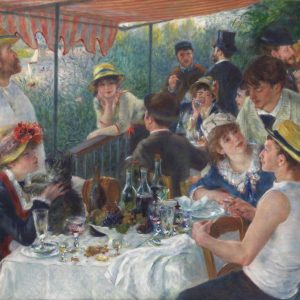
By the late 1870s, Renoir had achieved financial stability through portrait commissions and began to distance himself from the Impressionist group, feeling its focus on spontaneity was artistically limiting. A trip to Italy in 1881-82 proved to be a major turning point. After studying the works of Renaissance masters like Raphael, Renoir became convinced that Impressionism lacked the structural integrity and timeless quality of classical art. He felt he had reached the movement’s limits and needed a new direction. This shift was already evident in his celebrated work, Luncheon of the Boating Party (1881), completed just before his trip. His subsequent paintings became more focused on form, line, and solid composition, drawing inspiration from classical traditions.
Late Years and Legacy
In his later years, Renoir suffered from severe arthritis and other health problems but remained incredibly productive. He moved with his family to the warmer climate of Cagnes-sur-Mer on the French Riviera. There, encouraged by his dealer Ambroise Vollard, he began to explore sculpture, creating several pieces with the assistance of the sculptor Richard Guino. His late paintings adopted a more monumental, sculptural quality, moving away from the pure light effects of his contemporaries Monet and Degas and toward a greater sense of permanence and form. Renoir died of a heart attack in 1919, having lived to see his paintings hung in the Louvre. Along with Monet, he is considered a founder of Impressionism, yet his willingness to evolve beyond the movement’s initial principles helped lay the groundwork for modern artists like Cézanne and deeply influenced later masters such as Matisse and Picasso.