
Irène Cahen D’Anvers
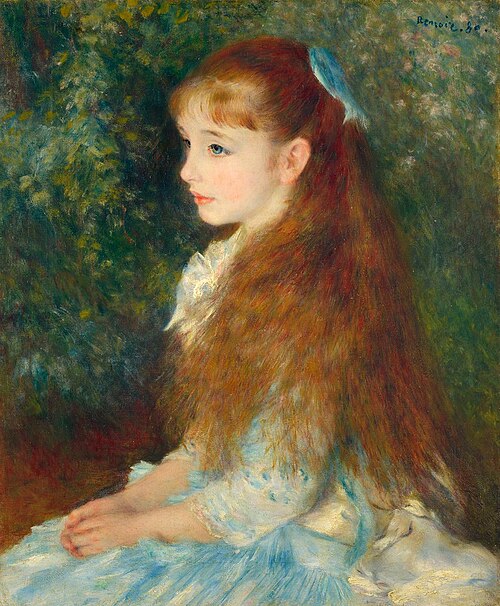

Portrait of Irène Cahen d’Anvers (1880), also known as Little Irene, is a distinguished Impressionist painting by Pierre-Auguste Renoir. Measuring 65 by 54 centimeters and housed in the Foundation E.G. Bührle Collection, Zurich, it portrays the young daughter of Parisian banker Louis Cahen d’Anvers with a poised yet contemplative expression. Renoir’s fluid brushwork and vibrant palette capture the luminosity of her skin and the texture of her clothing, blending realism with Impressionist spontaneity. The painting explores themes of childhood innocence and social standing, and despite an initially complicated reception, it has become one of Renoir’s most acclaimed portraits.
Ratings / Reviews
Información adicional
| Dimensions | Original: 65 cm x 54 cm, Small: 52 cm x 43.2 cm, Medium: 78 cm x 64.8 cm, Large: 91 cm x 75.6 cm |
|---|
$396.00 – $684.00Price range: $396.00 through $684.00
Completed in 1880, Portrait of Irène Cahen d’Anvers, often referred to as Little Irene, is one of Pierre-Auguste Renoir’s most celebrated works from his Impressionist period. Painted in oil on canvas and measuring 65 by 54 centimeters, the portrait is currently part of the Foundation E.G. Bührle Collection in Zurich. This intimate depiction of Irène, the young daughter of a wealthy Parisian banker, exemplifies Renoir’s capacity to capture both the physical presence and the ephemeral spirit of childhood through his distinctive painterly technique.
The subject, Irène Cahen d’Anvers, was one of three daughters of Louis Cahen d’Anvers, a prominent Jewish financier in late 19th-century Paris. The portrait reveals her poised yet natural demeanor, with her gaze directed slightly away from the viewer, which imbues the work with a contemplative mood beyond mere representation. The careful composition balances formality with the spontaneity characteristic of Impressionism, positioning the young girl within a softly defined interior that complements her youthful elegance.
Renoir’s hallmark loose and fluid brushwork animates the canvas, capturing the luminous quality of Irène’s skin and the texture of her dark hair and clothing. The vibrant palette and subtle modulations of light create an impression of vivacity and grace, rendering the sitter both tangible and radiant. The painting’s attention to detail, combined with its painterly freedom, exemplifies the fusion of realism and impressionistic sensibility that defined Renoir’s mature style.
Beyond its aesthetic qualities, the portrait engages with themes of childhood innocence and social status. While commissioned by Louis Cahen d’Anvers, the painting initially met with his dissatisfaction and was relegated to the servants’ quarters. It was later recognized as a masterpiece, exhibited at Renoir’s first solo show in 1883. The work’s turbulent provenance includes its confiscation by the Nazis during World War II and eventual acquisition by the Swiss collector Emil Georg Bührle.
As an outstanding example of Impressionism, Portrait of Irène Cahen d’Anvers embodies Renoir’s artistic innovations in capturing the personality and spirit of his subjects. It remains a poignant testament to the enduring allure of childhood and the artist’s sensitive vision.