
The Goldfinch
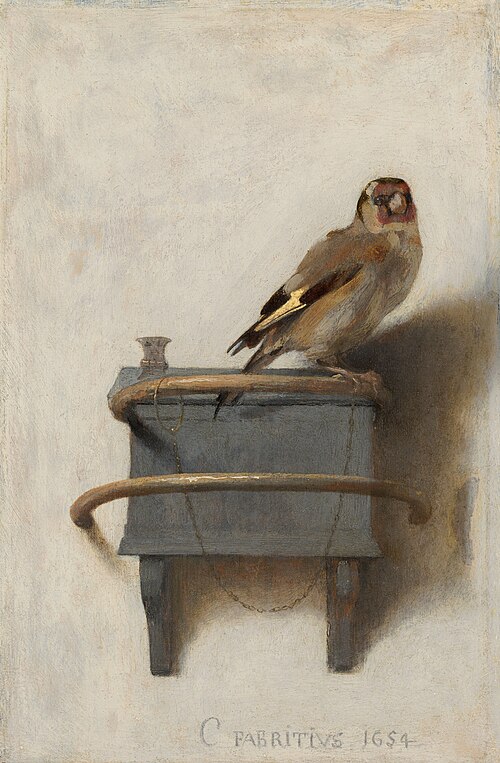

The Goldfinch (34 cm × 23 cm) by Carel Fabritius is a Baroque trompe-l’œil masterpiece depicting a live goldfinch tethered to a perch. Celebrated for its lifelike presence and elegant simplicity, it survived the explosion that killed the artist. Now housed in the Mauritshuis, it remains one of the most moving works of 17th-century Dutch art.
Ratings / Reviews
Información adicional
| Dimensions | Original: 34 cm x 23 cm, Small: 26.4 cm × 18.4 cm, Medium: 39.6 cm × 27.6 cm, Large: 46.2 cm × 32.2 cm |
|---|
$196.00 – $339.00Price range: $196.00 through $339.00
The Goldfinch is a small yet extraordinary masterpiece by Dutch artist Carel Fabritius, a pupil of Rembrandt and an early innovator within the Baroque movement. Painted in 1654, this work captures a moment of stillness and liveliness all at once. It depicts a European goldfinch (puttertje in Dutch) perched atop a blue feeder, mounted against a stark whitewashed wall. Tethered by a delicate chain, the bird is rendered with an almost haunting sense of immediacy—alive, alert, and seemingly just one movement away from flight.
Unlike the traditional trompe-l’oeil still lifes of the era—many of which depicted dead birds—Fabritius’s Goldfinch is undeniably alive. This deliberate contrast redefines the genre, subverting expectations and inviting a more emotional connection with the subject. The vitality of the bird is emphasized through loose, expressive brushwork, particularly in the feathers and the foreshortened head, while the metallic feeder rings and delicate chain are rendered with sharp precision. This stylistic balance conveys both realism and artistic interpretation, creating a three-dimensional illusion that is best appreciated from a slight distance.
The candid simplicity of the composition is a large part of its emotional and visual power. Fabritius chose not to crowd the frame with decorative elements. Instead, the stark background and soft cast shadows enhance the lifelike illusion and atmospheric depth. The shadows—of the bird, the feeding box, and the curved metal ring—are essential to the spatial coherence of the work, making the bird appear as if it is part of the viewer’s world.
Technical analysis conducted in 2003 offered fascinating insight into the painting’s history. The panel once had a gilded frame, affixed with ten nails, suggesting it may have been part of a larger piece of furniture—possibly the door of a cabinet or an integrated decorative object. Additionally, small indentations on the surface of the panel suggest that The Goldfinch may have survived the catastrophic Delft gunpowder explosion that killed Fabritius and destroyed much of the city, including the artist’s studio. That the work endures today seems miraculous to many, enhancing its spiritual and cultural significance.
Today, The Goldfinch is housed in the Mauritshuis in The Hague, Netherlands, where it remains one of the most beloved treasures of Dutch Baroque painting. Its fame was reignited in the 21st century by Donna Tartt’s Pulitzer Prize-winning novel The Goldfinch, in which the painting plays a central symbolic role—introducing this haunting masterpiece to an entirely new generation of admirers.